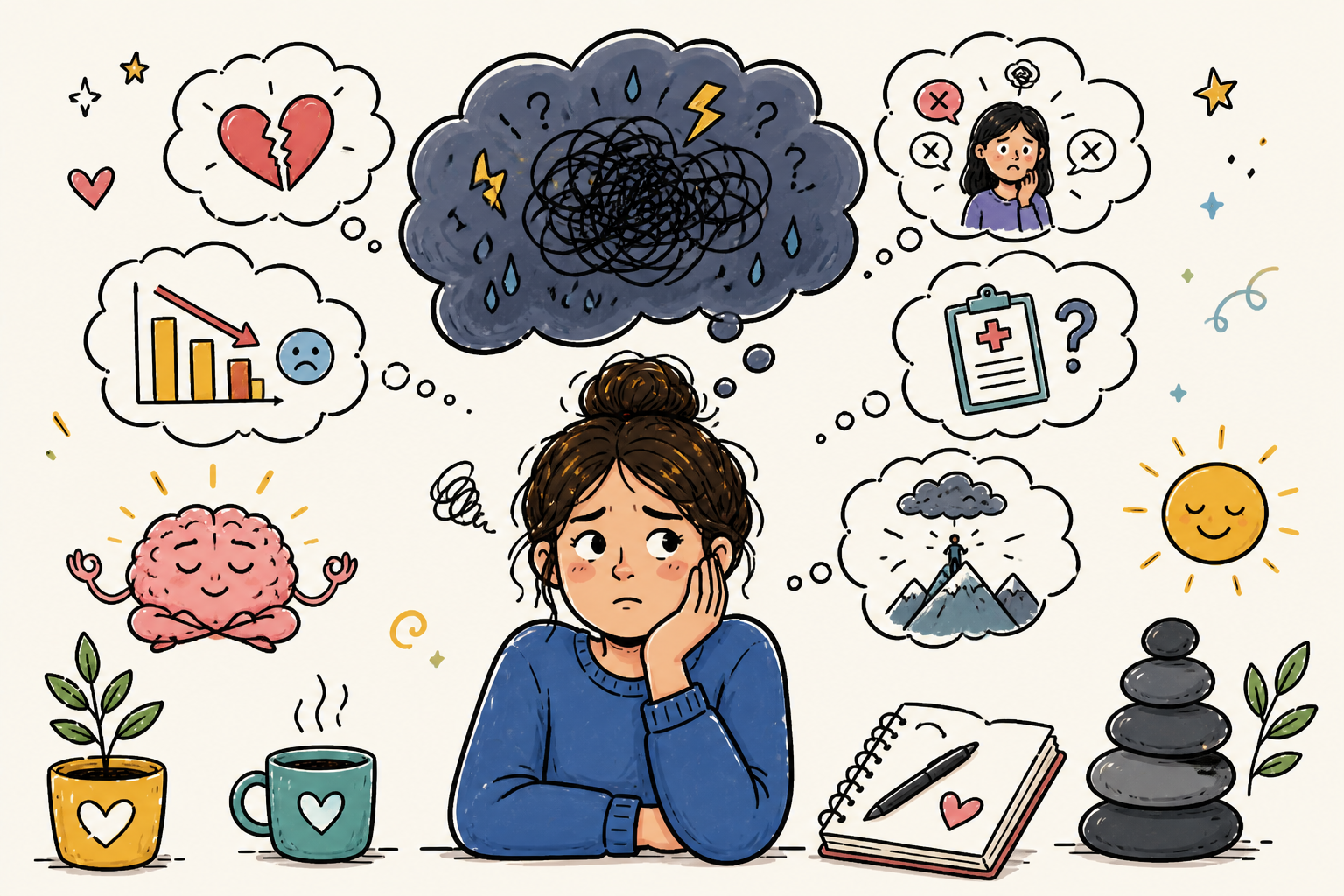

You send a message and don’t get a reply.
Within minutes, your brain begins constructing possibilities:
Did I say something wrong? Are they upset? Did something happen?
- A delayed email becomes a sign of professional failure.
- A mild headache turns into a health scare.
- One awkward conversation replays as social disaster.
This is the mind’s habit of creating worst-case scenarios—and for many people, it happens automatically.
The frustrating part is that you often know the fear is exaggerated, yet it still feels believable.
So why does the brain do this?
The answer is not weakness, negativity, or overdramatic thinking. It is a protective mechanism—one that can become overactive in modern life.

The Brain Is Wired to Anticipate Threat
"Human brains evolved for survival, not peace of mind."
Thousands of years ago, assuming the worst could keep you alive. If a rustle in the bushes might be a predator, it was safer to react as though it was.
This tendency is called threat anticipation—the brain’s ability to predict danger before it happens.
In today’s world, physical threats are less common, but the brain still uses the same system.
The difference is that now the “danger” is often emotional, social, or imagined.
Instead of predators, we fear rejection, embarrassment, failure, uncertainty, or loss.
Your mind treats these as risks to your well-being, so it prepares for them by imagining possible outcomes—often the worst ones.
Why Worst-Case Thinking Feels So Convincing
Catastrophic thoughts often feel real because they are emotionally charged.
The brain does not always distinguish between a genuine threat and a vividly imagined one.
If you picture something bad happening, your body may react with tension, increased heart rate, and anxiety—even though the event has not occurred.
That physical response reinforces the thought.
Suddenly, the scenario feels important simply because it triggered emotion.
This creates a loop:
- fearful thought
- emotional reaction
- stronger belief in the thought
The more often this happens, the easier it becomes for your mind to default to disaster-based thinking.
Uncertainty Becomes the Fuel
At the core of worst-case scenarios is one uncomfortable truth: uncertainty.
"The human mind dislikes not knowing."
When answers are incomplete, the brain fills in gaps.
For some people, it fills them with possibility. For others, especially under stress, it fills them with fear.
Why?
If you imagine the worst, you feel less vulnerable to surprise.
"It becomes a mental strategy: If I expect disaster, I’ll be ready for it."
But in reality, this does not create control—it creates chronic anxiety.
Past Experiences Shape Present Thinking

If you have experienced sudden disappointment, betrayal, criticism, or instability, your mind may become more alert to potential problems.
It learns that bad outcomes are possible—and starts scanning for signs of them.
This is not irrational.
It is pattern recognition based on lived experience.
The challenge is that past pain can train the brain to overestimate future danger.
A previous emotional wound may cause neutral situations to feel threatening. That is why a small issue today can trigger a disproportionately intense reaction.
Your mind is not just responding to the present-it is referencing history.
Social Media and Information Overload Make It Worse
Modern life amplifies worst-case thinking.
Constant exposure to alarming headlines, curated success stories, and endless comparison increases mental vigilance.
Your nervous system rarely gets true rest.
The brain becomes accustomed to scanning, reacting, and processing large volumes of emotional information.
That overstimulation lowers your threshold for stress.
When the mind is already fatigued, it is more likely to interpret uncertainty negatively.
This is one reason overthinking often intensifies after long periods online. Digital overload creates fertile ground for catastrophic thinking.
How to Interrupt the Pattern
The goal is not to stop thoughts entirely, but to change your relationship with them.
Start by identifying the pattern.
When you notice yourself spiraling, ask:
"What facts do I actually have?"
Separate evidence from assumption. Then challenge the urgency of the thought.
When thoughts begin spiraling, putting them on paper often reduces their emotional intensity like pn a guided journal.
Is this the most likely outcome—or simply the most feared one? This question creates psychological distance.
It reminds you that possibility is not probability.
Another helpful strategy is grounding yourself in the present.
Worst-case scenarios live in the future. Returning attention to what is happening right now reduces their power.
Slow breathing, movement, and limiting overstimulation can all help regulate the nervous system.
Your Thoughts Are Not Predictions
One of the most important truths to remember is this:
Your mind can imagine countless possibilities, but imagination is not evidence.
Worst-case thinking often reflects fear, not reality.
The brain’s job is to generate scenarios—not to determine which one will happen. That final judgment belongs to you.
Learning to observe thoughts without immediately believing them is a skill. And like any skill, it strengthens with practice.
The Bottom Line
Your mind creates worst-case scenarios because it is trying to protect you.
It wants certainty, safety, and preparedness.
But when protection turns into constant anticipation of disaster, peace becomes difficult to access.
Understanding this pattern is the first step toward changing it.
The next step is remembering that not every fear deserves your trust.
Your thoughts may be loud, detailed, and emotionally persuasive—but that does not make them true.
Sometimes the healthiest response is not solving the imagined problem but refusing to live inside it.
Read more about remedial actions for anxiety here: How Self-Talk, Breathwork and Intention Shape Anxiety