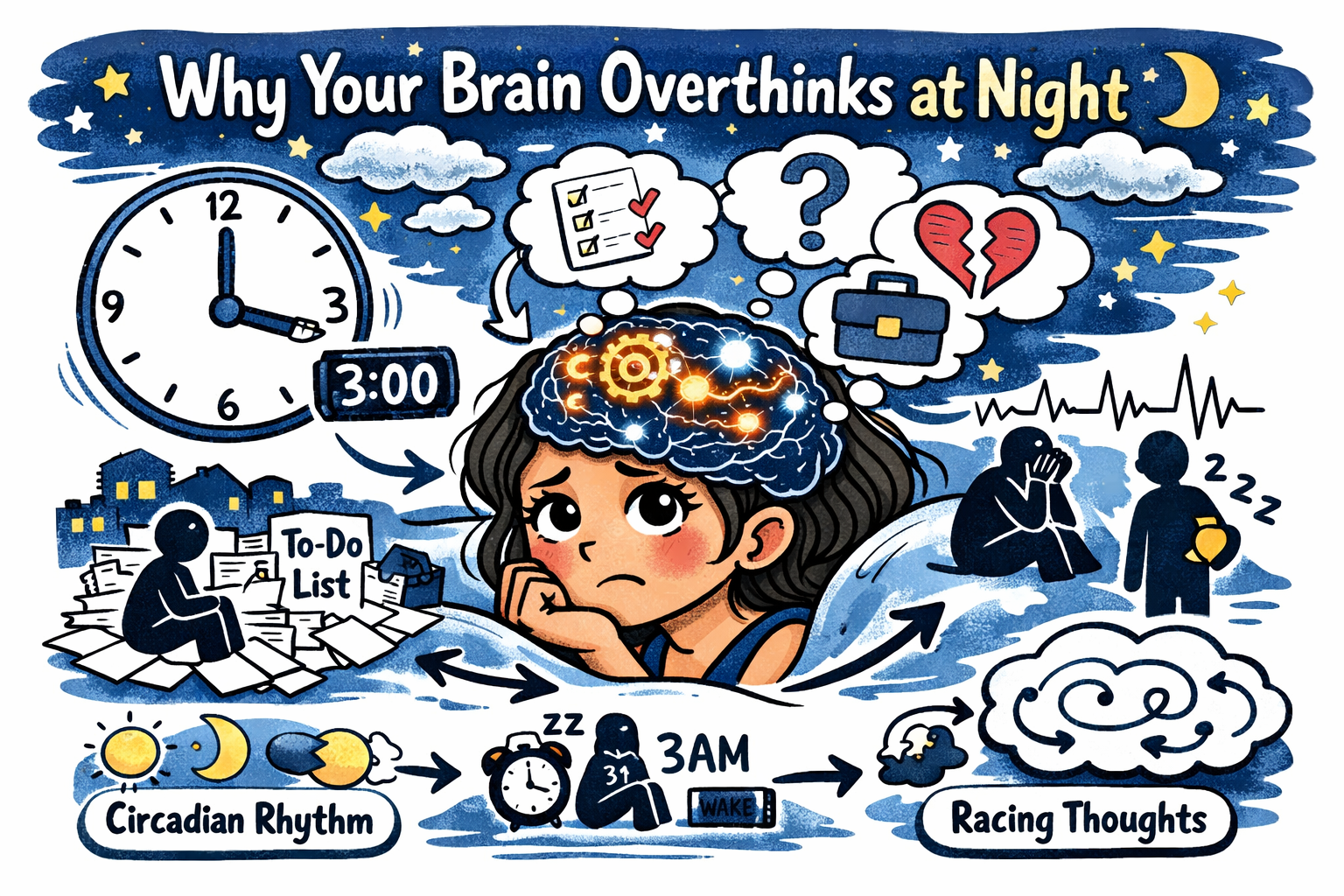

You finally lie down after a long, exhausting day. Your body is tired, your eyes are heavy but your mind? Wide awake.
Suddenly, every small worry, awkward conversation, and future fear comes rushing in. You replay things you said, imagine things that could go wrong, and overanalyze situations that didn’t seem important during the day.
So why does your brain do this at night?

Let’s break it down.
Your Brain Doesn’t “Slow Down” at Night—It Shifts Mode
During the day, your brain is busy handling tasks, conversations, notifications, and responsibilities. It’s in action mode, constantly distracted and engaged.
But at night, everything changes.
There are no distractions. No noise. No tasks.
That’s when your brain switches to reflection mode.
This is when it starts:
- Processing unresolved thoughts
- Revisiting emotional experiences
- Trying to “make sense” of your day
In simple terms: your brain finally gets time to think, and it goes all in.
The Role of Anxiety and Silence

At night:
- External noise decreases
- Internal thoughts become louder
- Small worries feel bigger
Your brain is wired to detect problems. So when things go quiet, it starts searching for things to fix—even if nothing is actually wrong.
Why Negative Thoughts Take Over
Ever noticed how your thoughts at night are rarely positive?
That’s because your brain has a built-in negativity bias.
It prioritizes:
- Mistakes over achievements
- Risks over safety
- Problems over peace
This goes back to survival.
So at night, when your mind is free, it often drifts toward:
- “What if I fail?”
- “Did I say something wrong?”
- “What will happen tomorrow?”
Your Body Is Tired, But Your Mind Isn’t
Another reason you overthink at night is simple:
Your body and mind don’t shut down at the same time.
Physically, you’re exhausted. But mentally, your brain may still be active—especially if:
- You’ve been stressed during the day
- You didn’t get time to process your thoughts
- You were constantly distracted
So, when you finally stop, your brain “catches up.”
Overthinking Is Your Brain Trying to Protect You
Here’s something important:
Overthinking isn’t your brain working against you, it’s trying to help.
It’s attempting to:
- Prepare you for future situations
- Prevent mistakes
- Solve unresolved problems
The problem is, it often overdoes it, turning helpful thinking into endless loops.
How to Calm Your Mind at Night
You don’t need to “turn off” your brain—you just need to guide it.
Here are simple techniques that actually work:
1. Do a “Brain Dump”
Write down everything on your mind before bed. This signals your brain:
“You don’t need to remember this right now.”
2. Control Your Breathing
Try this:
- Inhale for 4 seconds
- Exhale for 6 seconds
This slows your nervous system and reduces mental activity.
3. Reduce Nighttime Stimulation
Avoid:
- Phone scrolling
- Intense content
- Work-related thinking
Give your brain time to wind down.
4. Create a Night Routine
Simple habits like dim lighting, calm music, or reading can signal your brain:
“It’s time to relax.”
A Tool That Can Help
If you struggle with constant overthinking, a helpful read is:
“The Power of Now” by Eckhart Tolle. This book focuses on staying present and not getting trapped in endless thought loops, especially helpful for nighttime anxiety.
Final Thought
Your brain overthinks at night not because something is wrong—but because it finally has the space to think.
The goal isn’t to silence your mind completely. It’s to create enough calm that your thoughts don’t control you.
And once you learn that nights start to feel a lot more peaceful.
Read this blog to stay calm under press: Why Do Some People Stay Calm under Pressure (and How You Can Too)