
For a while, it seemed like the Middle East had slipped out of the center of global attention. The world was focused on Ukraine, the US-China rivalry, artificial intelligence, and economic slowdowns.
But now, the Middle East is once again becoming one of the most dangerous regions on Earth.
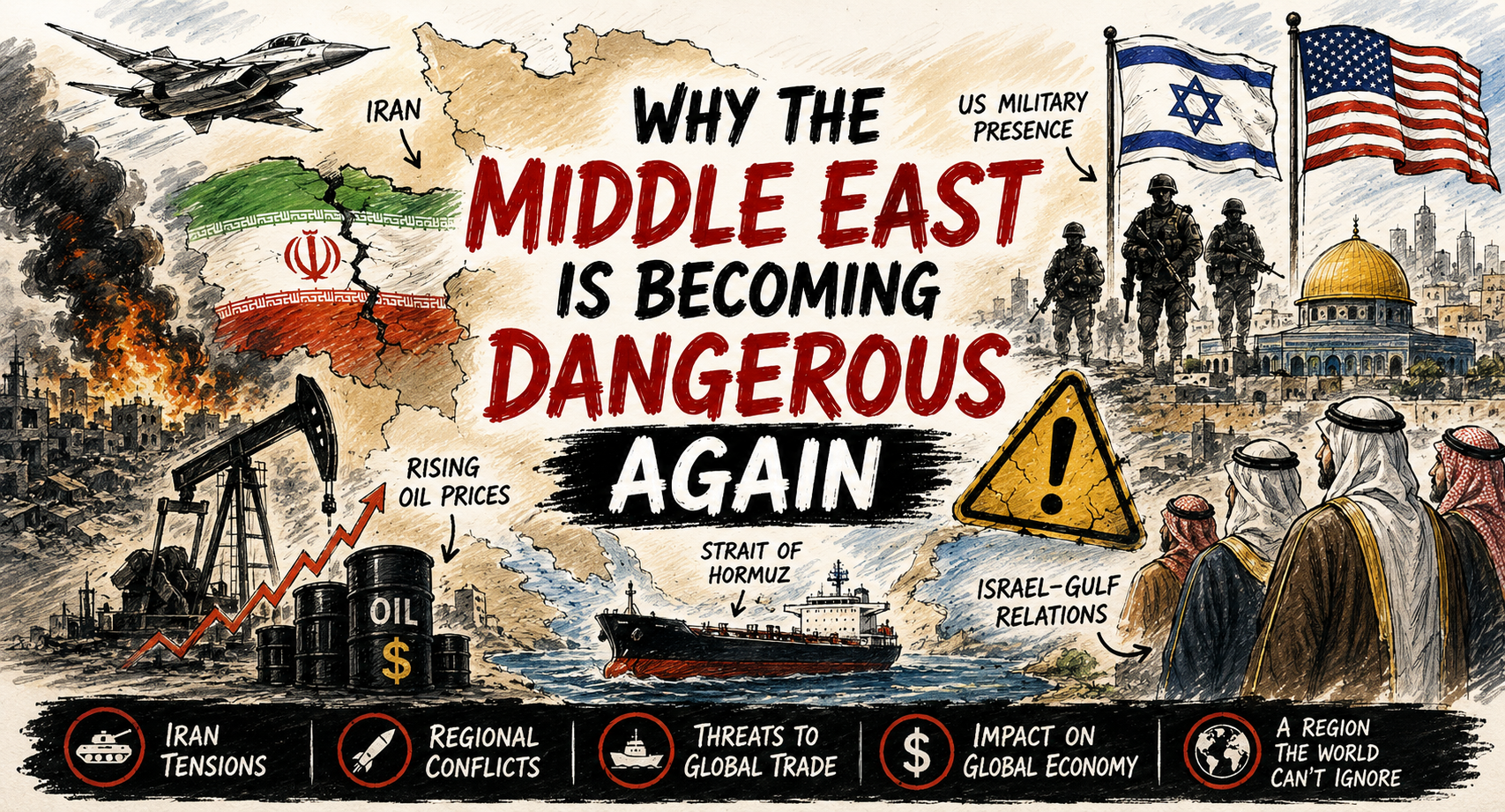
From rising Iran tensions and military movements to fragile Gulf alliances and fears over oil supply disruptions, global powers are closely watching every development in the region. Investors are nervous, governments are recalculating strategies, and energy markets are reacting almost instantly to every escalation.

This is not just another regional conflict story anymore. What happens in the Middle East now has the potential to impact inflation, fuel prices, global trade, and international security far beyond the region itself..
Why the Middle East Matters So Much Globally
The Middle East remains strategically important for one major reason: energy.
A large portion of the world’s oil and gas flows through this region, especially through the Strait of Hormuz — one of the world’s most critical shipping routes. Even the possibility of conflict near this narrow waterway can push oil prices upward overnight.
Countries across Asia, Europe, and even North America depend on stable Middle Eastern energy supplies. Any instability affects:
- fuel prices
- airline costs
- inflation
- shipping
- food supply chains
- stock markets
That is why global markets react so strongly whenever tensions rise between countries like Iran, Israel, Saudi Arabia, or the United States.
Iran Is Back at the Center of Global Tensions
Iran has once again become a major geopolitical flashpoint.
Western governments remain deeply concerned about Iran’s expanding regional influence and its nuclear ambitions. At the same time, Iran continues strengthening ties with regional armed groups and political allies across the Middle East.

The situation has become increasingly volatile because several conflicts are now interconnected:
- Iran’s rivalry with Israel
- proxy conflicts across the region
- maritime security concerns
- Western sanctions
- military posturing by the United States
Every small escalation now carries the risk of triggering a broader regional confrontation.
The United States Is Increasingly Drawn Back In
Despite years of trying to reduce its involvement in the Middle East, United States continues to maintain a heavy military presence across the region.
American naval forces remain active near key shipping routes, while US military bases across Gulf countries continue to play a strategic role in regional security.
Washington faces a difficult balancing act:
- supporting allies like Israel
- protecting oil trade routes
- countering Iran’s influence
- avoiding another large-scale military conflict
This balancing act has become harder as tensions continue rising.
Many analysts believe the US no longer wants another prolonged Middle Eastern war. However, the region’s instability keeps pulling Washington back into crisis management.
Israel and Gulf Nations Are Entering a New Phase
One of the most significant shifts in recent years has been the changing relationship between Israel and several Gulf nations.
Some Arab states have expanded diplomatic and economic cooperation with Israel, largely due to shared concerns over Iran’s growing influence. These evolving alliances have reshaped regional politics dramatically.
But this also creates new tensions.
The Middle East now has overlapping rivalries involving:
- Iran
- Israel
- Gulf monarchies
- US interests
- regional armed groups
This complicated network of alliances makes the region highly unpredictable.
Oil Markets Are Watching Every Move

One reason the world is reacting so strongly is because energy markets remain extremely sensitive.
Whenever tensions escalate:
- oil prices rise
- investors panic
- global inflation fears return
For countries like India, this becomes especially important because higher crude oil prices directly affect:
- petrol and diesel costs
- transport
- food prices
- household expenses
- economic growth
India imports a major portion of its energy requirements, meaning Middle Eastern instability can quickly impact ordinary citizens thousands of kilometers away.
Why This Crisis Feels Different
The current situation feels more dangerous because multiple global crises are happening at the same time.
The world is already dealing with:
- US-China competition
- the Russia-Ukraine war
- economic uncertainty
- AI-driven geopolitical rivalry
Now, renewed instability in the Middle East adds another layer of global tension.
Unlike isolated regional conflicts in the past, today’s geopolitical environment is deeply interconnected. A disruption in one region can rapidly affect markets, diplomacy, and security worldwide.
The World Cannot Ignore the Middle East
For years, many believed the Middle East was becoming less central to global politics.
That assumption is now fading.
The region still sits at the heart of:
- global energy supply
- strategic military routes
- religious and political rivalries
- international diplomacy
And as tensions rise again, the world is realizing that instability in the Middle East never stays confined to the Middle East alone.
Whether through oil prices, military escalation, or global economic shocks, the consequences reach everywhere.
If you want to understand how today’s Middle East tensions connect to the larger global power struggle, read our latest breakdown of Trump’s high-stakes China visit and what it means for world politics.