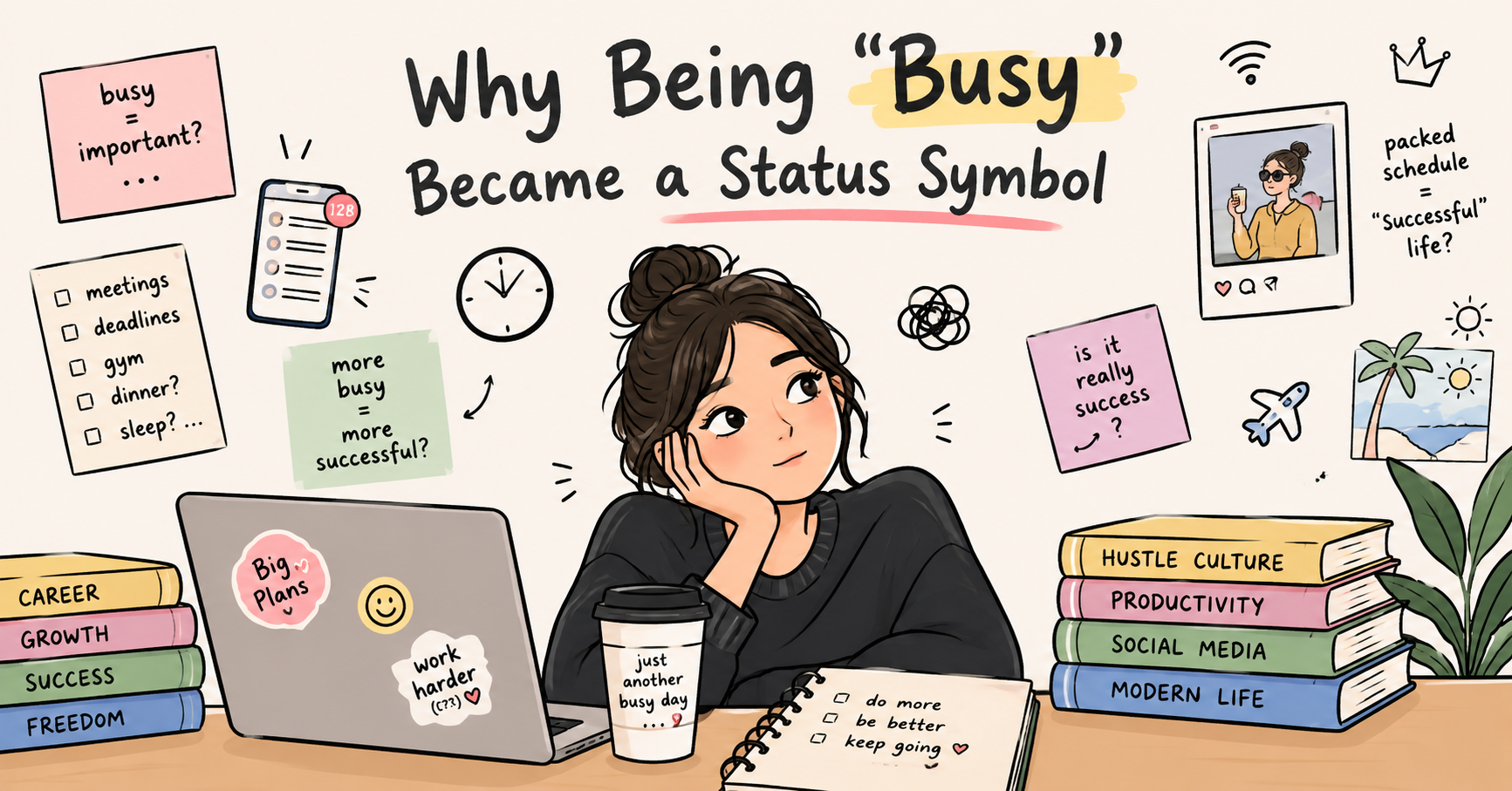

There was a time when being busy simply meant you had a lot to do.
Today, it can mean something much bigger.
“I've been so busy.”
“I barely have time to sleep.”
“My calendar is completely packed.”
“I have three meetings today, then a deadline, then the gym.”
We often say these things casually. But somewhere along the way, being busy stopped being just a description of our lives and became a way of communicating our value.
Being busy can make us feel important, productive and even successful.
But why?
Why has having no free time become something many people almost want to show off?
The answer has a lot to do with status, productivity culture, social media and the way modern society measures success.
What Does It Mean When “Busy” Becomes a Status Symbol?
A status symbol is something that communicates a person's social position, success, wealth or importance.
Traditionally, status symbols included expensive cars, designer clothes, luxury homes and exotic holidays.
But modern status isn't always something you can buy.
Sometimes, it's something you don't have.
And increasingly, that thing is free time.
When someone constantly talks about being busy, they may unintentionally communicate:
“My time is valuable because so many people and responsibilities need it.”
A packed schedule can therefore become a subtle form of social currency.
The strange part?
We often complain about being overwhelmed while simultaneously feeling proud of how much we have on our plate.
The Rise of “Busy Culture”
This phenomenon is often connected to busy culture, a social environment where constant activity is associated with ambition, productivity and success.
The underlying idea is simple:
If you're busy, you must be doing something important.
And if you're not busy?
You might feel as though you're falling behind.
This mindset can affect students, employees, entrepreneurs and even people who work from home.
A completely free Sunday can feel uncomfortable.
An empty calendar can feel like wasted potential.
Taking a nap can feel less acceptable than answering emails.
Doing nothing can feel strangely guilty.
That's when being busy stops being a temporary situation and becomes part of someone's identity.
Why Do We Feel Proud of Being Busy?
1. Busy Makes Us Feel Important
At a psychological level, being needed can feel rewarding.
If your manager constantly needs you, your friends rely on you, your family needs your help and your calendar is full, it can create the feeling that you matter.
Being busy becomes evidence that you're relevant.
This can be particularly powerful in competitive environments.
Someone saying:
“I have nothing to do today.”
may feel less impressive than:
“I have back-to-back meetings all day.”
The second statement sounds productive, even though meetings don't necessarily produce meaningful results.
2. We Confuse Activity With Productivity
This is one of the biggest problems with busy culture.
Being busy and being productive are not the same thing.
You can spend ten hours answering messages, attending meetings and checking notifications without completing the one task that actually matters.
Productivity is about meaningful output.
Busyness is often about visible activity.
Think about the difference:
Busy:
- Checking emails repeatedly
- Attending unnecessary meetings
- Constantly switching between tasks
- Responding immediately to every notification
- Filling every free moment with something
Productive:
- Completing important work
- Solving problems
- Learning something valuable
- Making meaningful progress
- Taking enough rest to maintain performance
The two can overlap, but they are certainly not identical.
3. Social Media Made Busyness More Visible
Social media has changed how we present our lives.
People don't just share what they own anymore.
They share what they're doing.
A perfectly organized desk.
A laptop at a coffee shop.
A morning workout.
A productivity planner.
A business meeting.
A late-night work session.
A packed travel itinerary.
A screenshot of a calendar full of appointments.
Even exhaustion can become content.
The message can be subtle:
“Look how much I have going on.”
Social media therefore creates an environment where productivity can become part of personal branding.
The “That Girl” Effect and Productivity Aesthetics
Modern internet culture has also made productivity visually attractive.
You may have seen videos featuring:
- 5 a.m. wake-up routines
- perfectly organized planners
- morning workouts
- journaling
- studying
- working from cafés
- elaborate to-do lists
- “day in my life” videos
- long study sessions
There's nothing inherently wrong with these habits.
The problem begins when looking productive becomes more important than actually feeling fulfilled.
A beautifully organized planner doesn't automatically mean you're having a productive day.
And waking up at 5 a.m. isn't automatically better than waking up at 7 a.m.
Productivity has increasingly become an aesthetic.
4. Hustle Culture Changed the Definition of Success
The rise of hustle culture pushed this idea even further.
The popular message was:
Work harder. Work longer. Build something. Never stop.
Entrepreneurs were praised for sleeping less.
Students were praised for constantly studying.
Employees were praised for answering emails after work.
Side hustles became almost mandatory in some online spaces.
Rest, meanwhile, could look like laziness.
This created a dangerous equation:
More work = more ambition = more success.
But human beings don't work like machines.
Constant activity eventually comes with diminishing returns.
5. Free Time Can Feel Like Failure
This is perhaps the most interesting part.
Why do some people feel guilty when they have nothing planned?
Because modern culture has trained many of us to associate empty time with wasted time.
Consider the phrase:
“I wasted the whole day.”
What does it usually mean?
Often, it means we didn't accomplish enough.
But what if you spent the day resting because you needed it?
What if watching a movie, taking a walk, talking to a friend or simply sitting quietly wasn't wasted time at all?
The problem isn't having goals.
The problem is believing that every moment must produce something.
The Psychology Behind the Need to Stay Busy
There is another side to constant busyness.
Sometimes people stay busy because it helps them avoid uncomfortable thoughts or emotions.
When every hour is filled with work, entertainment, social media, errands and commitments, there is little room to simply sit with your thoughts.
Busyness can therefore become a distraction.
Instead of asking:
“Am I actually happy with how my life is going?”
we keep asking:
“What do I need to do next?”
Of course, being busy doesn't automatically mean someone is avoiding their feelings.
But for some people, constant activity can become a way of avoiding stillness.
Why Saying “I'm Busy” Feels So Powerful
Think about what the phrase communicates.
When someone says:
“I'm busy.”
they may be communicating several things at once:
- I have responsibilities.
- People depend on me.
- My time is valuable.
- I'm working toward something.
- I have goals.
- I don't have time to waste.
That's why busyness can function as a social signal.
It tells other people that your life has demand.
In a strange way, scarcity creates value.
We see the same principle everywhere else.
Limited-edition products feel more desirable.
Exclusive events feel more prestigious.
Rare experiences feel more valuable.
And now, limited personal time can also feel like a sign of importance.
But Is Being Busy Actually Impressive?
Not necessarily.
A full schedule doesn't tell us whether the things filling it are meaningful.
Someone can be extremely busy and completely directionless.
Another person can have a relatively simple schedule and be making extraordinary progress.
Consider two people.
Person A: Works 12 hours a day, attends countless meetings and constantly checks email.
Person B: Works six focused hours, exercises, spends time with family and has evenings free.
Who is more productive?
You can't answer that simply by looking at their schedules.
The quality of the work matters more than the number of hours.
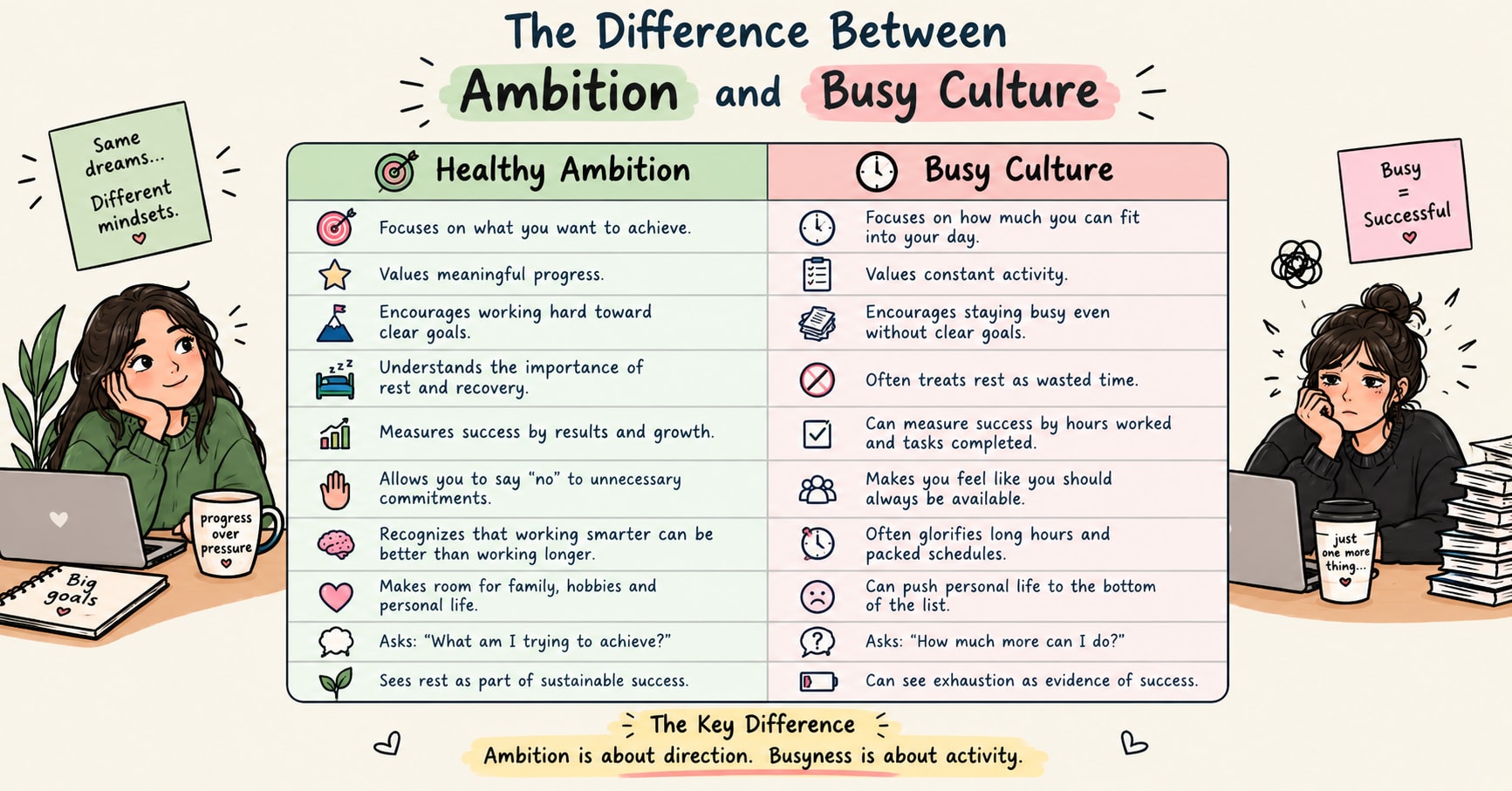
The Difference Between Ambition and Busy Culture
How to Stop Treating Busyness Like a Status Symbol
You don't need to completely change your lifestyle.
Instead, start questioning the assumptions behind your schedule.
Ask yourself:
Does this actually need to be done?
Not everything deserves your time.
Am I productive or simply occupied?
Activity isn't automatically progress.
Would I still do this if nobody knew about it?
This is particularly useful when social media is involved.
When was the last time I rested without feeling guilty?
If you can't remember, that's worth noticing.
What would happen if my calendar had some empty space?
Sometimes, nothing.
And that's perfectly okay.
Why Having Free Time Might Become the New Luxury
There's an interesting possibility emerging from all this.
For years, wealth was often associated with having more things.
But as modern life becomes increasingly connected, another form of wealth becomes valuable:
time.
Having the ability to disconnect from work.
Having an afternoon with nothing planned.
Being able to take a holiday without checking email.
Having enough financial security to say no.
Being able to spend time with people you love.
In a world where everyone seems permanently available, having control over your time can become a genuine privilege.
Perhaps the ultimate status symbol isn't saying:
“I'm too busy.”
Maybe it's being able to say:
“I have time.”
The Bottom Line
Being busy isn't inherently bad.
Sometimes life really is busy.
There are deadlines, exams, jobs, families, businesses and responsibilities that demand our attention.
But somewhere along the way, busyness became tangled with identity and success.
We started measuring our worth through packed calendars, long working hours and endless to-do lists.
And social media made it even easier to turn productivity into performance.
The healthier goal isn't to become less ambitious.
It's to stop assuming that exhaustion is evidence of ambition.
Your worth isn't determined by how many things you can squeeze into a day.
Sometimes the most productive thing you can do is finish your work, close your laptop, put your phone away and have absolutely nothing to prove.