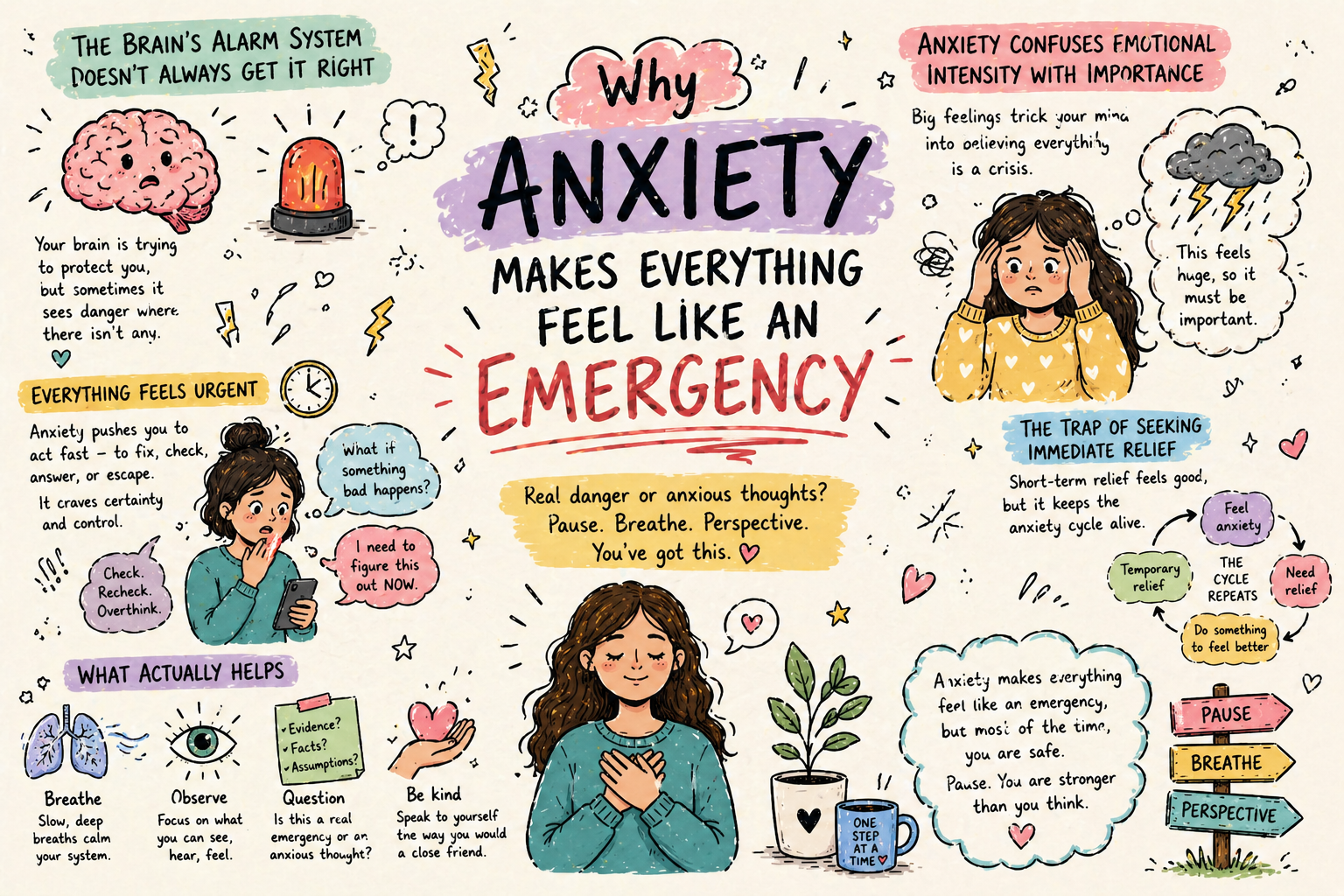

There are moments when anxiety does not feel like nervousness or worry-it feels like urgency.
A text goes unanswered for too long, and suddenly your mind is convinced something is wrong. A mistake at work feels like the beginning of disaster. A small physical symptom becomes a looming health crisis. Even ordinary silence can start to feel loaded with meaning.
In those moments, everything demands immediate attention. You feel the need to fix, solve, check, or escape—right now.
That is one of anxiety’s most convincing illusions: it turns discomfort into emergency.
And when it does, your body and mind respond as if the threat is real.
The Brain’s Alarm System Does Not Always Get It Right

Anxiety is deeply tied to the body’s survival system.
When the brain senses danger, it activates the fight-or-flight response. Heart rate increases, muscles tense, breathing becomes shallow, and focus narrows.
This response is useful in genuine emergencies. It prepares you to react quickly.
The problem is that anxiety can trigger the same system even when no real threat exists. A conversation, a thought, or even uncertainty itself can be misread as danger.
To the anxious brain, ambiguity often feels unsafe. And once the alarm goes off, the body does not pause to ask whether the fear is logical.
It reacts first. That is why anxiety can feel so physically convincing.
Why Everything Suddenly Feels Urgent
Urgency is one of anxiety’s most powerful tools.
When you feel anxious, your mind often searches for a way out of discomfort. It wants certainty, reassurance, or control.
That creates a strong impulse to act immediately:
- send another message
- search symptoms online
- replay the conversation
- make a quick decision
- avoid the situation entirely
These actions can feel like solutions, but they are often attempts to reduce emotional discomfort as fast as possible.
The issue is that they train the brain to believe urgency is necessary. Each time you rush to relieve anxiety, you reinforce the idea that the feeling itself is dangerous. That keeps the cycle alive.
Anxiety Confuses Emotional Intensity With Importance
Not every intense feeling deserves an immediate reaction. But anxiety makes emotional discomfort feel significant.
- A racing heart becomes proof that something is wrong.
- A worried thought feels like evidence.
- A moment of uncertainty becomes a crisis that must be solved.
This happens because anxiety amplifies perception. It gives ordinary experiences a false sense of magnitude.
The stronger the feeling, the more your brain assumes it matters. But feelings are signals—not always facts. Intensity does not equal truth.
That distinction is difficult to remember in anxious moments, but it is one of the most important.
The Trap of Seeking Immediate Relief
When anxiety peaks, immediate relief becomes the goal. And in the short term, reassurance often works.
Checking, asking, avoiding, or over-preparing may calm you for a moment. But the calm is temporary.
Soon the anxiety returns, often stronger, because the underlying fear was never processed—only silenced.
This is why anxiety can become repetitive. The brain learns that discomfort should be escaped quickly instead of tolerated.
Over time, even smaller triggers begin to feel urgent. The threshold lowers. What once caused mild concern now feels overwhelming.
What Actually Helps in the Moment

The solution is not to ignore anxiety, but to respond differently.
Instead of rushing to fix the feeling, start by slowing your response.
- Pause before acting.
- Take longer exhales to signal safety to your nervous system.
Name what is happening:
'This feels urgent, but it may not be an emergency.'
That sentence creates distance between the feeling and the reaction. Ground yourself in what is observable, not imagined.
Watch this video for the breathing: 4-7-8 Calm Breathing Exercise | 10 Minutes of Deep Relaxation | Anxiety Relief | Pranayama Exercise
Ask:
- What evidence do I have right now?
- What am I assuming?
- If I waited 20 minutes, would this still need immediate action?
Often, the intensity begins to soften when it is not fed.
Learning to Trust Calm Over Panic
Anxiety often teaches you to trust the loudest signal. But healing comes from learning to trust steadiness instead.
- Not every thought deserves attention.
- Not every feeling requires action. Not every uncertainty needs to be solved immediately.
The body can learn that it is safe even when answers are incomplete.
That process takes repetition.
It takes choosing pause over panic, curiosity over fear, and patience over urgency.
The Bottom Line
Anxiety makes everything feel like an emergency because it activates systems designed to protect you.
But protection can become overprotection.
When every discomfort is treated like danger, life starts to feel like constant crisis management.
The shift begins when you recognize urgency for what it often is: a nervous system asking for reassurance, not a sign that disaster is near.
And reassurance does not always come from solving the problem.
Sometimes it comes from staying present long enough to realize there was no emergency at all.
Read more when anxiety kicks in: How Self-Talk, Intention and Breathwork Shape Anxiety