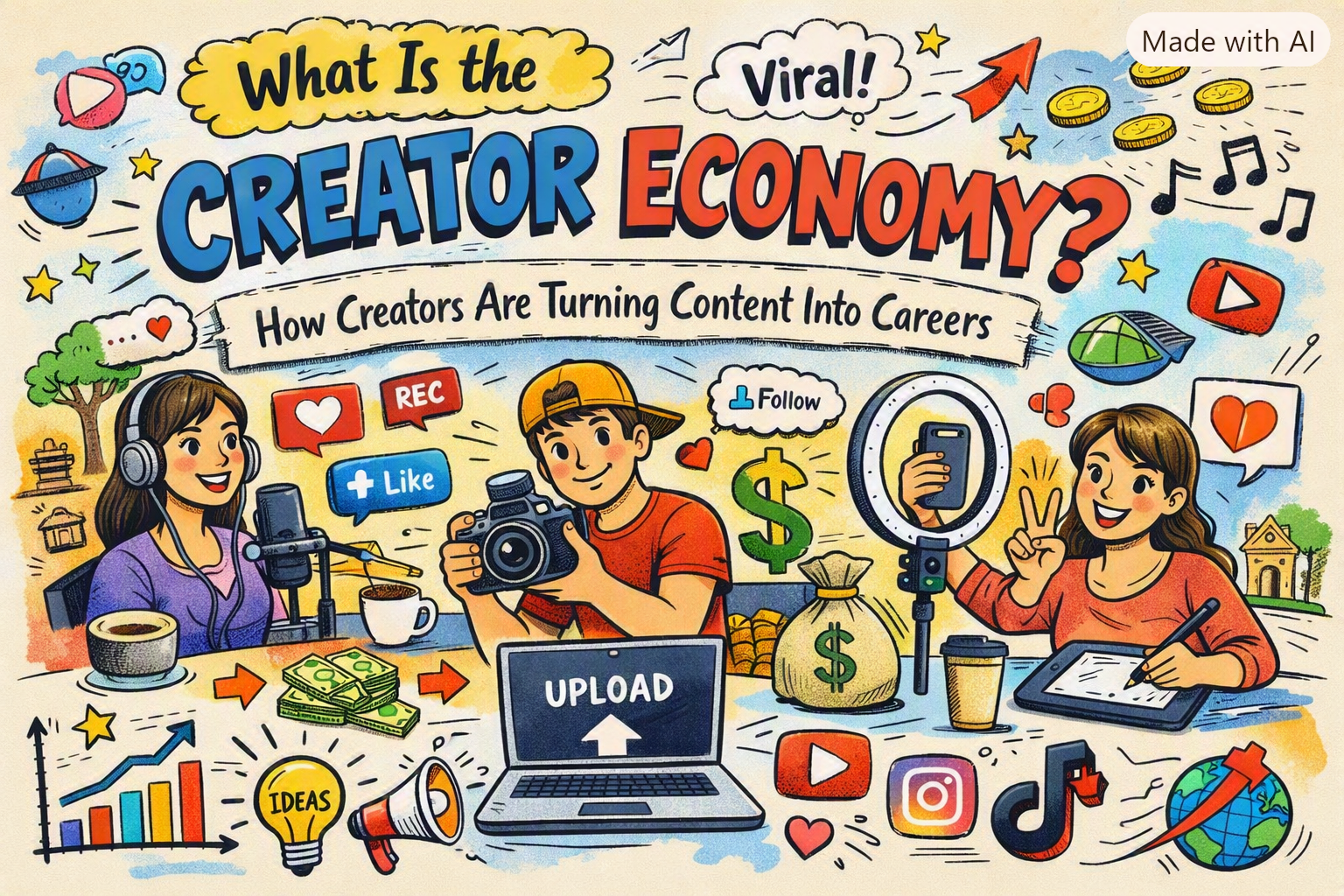

Scroll through Instagram, YouTube, TikTok, podcasts, newsletters, or even LinkedIn, and you will find people building businesses around something that used to be considered a hobby: creating content.
A person can now make videos from their bedroom, build an audience, recommend products, sell a digital course, work with brands, launch a subscription, or even turn a personal interest into a full-time business.
This entire ecosystem is known as the creator economy.
But what exactly does that term mean? Who is part of it? And how do creators actually make money?
Let's break it down.
What Is the Creator Economy?
The creator economy is the ecosystem built around people who create, distribute, and monetize content, products, or services directly through digital platforms and audiences.
Creators can include YouTubers, Instagram creators, bloggers, podcasters, streamers, newsletter writers, artists, educators, photographers, coaches, and many independent professionals.
The important change is that creators no longer necessarily need a traditional media company, publisher, television network, or employer to reach an audience.
They can build that relationship themselves.
The creator economy therefore involves much more than influencers posting sponsored pictures. It includes the creators, platforms, brands, audiences, payment systems, agencies, software tools, and businesses that support this ecosystem.
How Did the Creator Economy Begin?
The idea isn't completely new.
People have always made money from creative work. Writers sold books, musicians sold records, photographers worked for magazines, and television personalities built careers around their audiences.
What changed was the internet.
Social media and digital platforms dramatically reduced the barriers between an individual creator and a global audience.
Instead of needing a publisher to distribute your writing, you could start a blog.
Instead of needing a television network, you could start a YouTube channel.
Instead of needing a radio station, you could start a podcast.
Instead of opening a physical store, you could sell digital products online.
This shift gave individuals something that was previously difficult to obtain: direct access to an audience.
Who Is Part of the Creator Economy?
The creator economy is much broader than influencers.
1. Video creators
YouTubers, Instagram creators and short-form video creators can build audiences around entertainment, education, gaming, beauty, cooking, technology and countless other subjects.
2. Bloggers and writers
Bloggers can monetize through advertising, affiliate marketing, sponsorships, memberships and digital products.
3. Podcasters
Podcasters can generate revenue through advertising, sponsorships, subscriptions, memberships and partnerships.
4. Online educators
Teachers, coaches and experts can sell courses, workshops, ebooks, communities and consulting services.
5. Artists and designers
Illustrators, photographers, musicians and designers can use digital platforms to showcase their work and sell directly to customers.
6. Streamers and gamers
Gaming creators can earn through advertising, sponsorships, subscriptions, donations, memberships and merchandise.
7. Newsletter creators
Independent writers can build audiences through newsletters and monetize through paid subscriptions, sponsorships and products.
So, being part of the creator economy doesn't necessarily mean becoming an "influencer."
It means building economic value around your creative work and your relationship with an audience.
How Do Creators Make Money?
One of the biggest misconceptions about the creator economy is that creators simply get paid for views.
Views can certainly matter, but successful creators generally use multiple revenue streams.
Brand sponsorships
A company pays a creator to feature or promote its product.
For example, a beauty creator might collaborate with a skincare company, while a gaming creator might partner with a gaming hardware brand.
Advertising revenue
Platforms can share advertising revenue with eligible creators.
YouTube, for example, has established monetization programs that allow eligible creators to earn from advertising and other features.
Affiliate marketing
Creators recommend products and receive a commission when their audience makes a qualifying purchase through their affiliate link.
This is particularly common in beauty, fashion, technology, food and lifestyle content.
Digital products
Creators can sell:
- Ebooks
- Courses
- Templates
- Presets
- Guides
- Paid newsletters
- Digital artwork
- Educational resources
This can be particularly attractive because the creator owns the product rather than simply promoting someone else's.
Memberships and subscriptions
Some creators offer exclusive content or communities to paying members.
Merchandise
A creator with a strong community can sell clothing, accessories, artwork or other branded products.
Services
A creator may eventually turn their expertise into consulting, coaching, freelance work, photography, design, marketing or other services.
The result is that a creator can evolve from content creator → personal brand → small business.
Why Is the Creator Economy Growing So Quickly?
There are several reasons.
1. Starting has become easier
You don't necessarily need expensive equipment or a large studio to begin creating.
A smartphone and an internet connection can be enough to start.
The barrier to entry has fallen dramatically.
2. Audiences want authenticity
People often connect differently with individual creators than with traditional advertising.
A creator may explain how they actually use a product, share their experience with it, or demonstrate it in everyday life.
That personal relationship can make recommendations feel more relatable.
3. Platforms provide global distribution
A creator sitting in a small Indian city can potentially reach audiences across India and internationally.
This is particularly significant in India, where regional-language and non-metro creators are becoming an increasingly important part of the ecosystem.
A 2026 study from the Indian School of Business and Hashfame found that India's creator base grew from about 0.96 million in 2020 to 4.12 million in 2025, with non-metro creators accounting for 66% of the creator base in 2025.
That's a major shift.
The creator economy is no longer simply a Mumbai, Delhi or Bengaluru phenomenon.
The Creator Economy in India
India is becoming one of the world's most interesting creator markets.
According to a 2025 Boston Consulting Group analysis, India had approximately 2–2.5 million monetized content creators, influencing an estimated $350–400 billion in consumer spending. The report projected creator-influenced consumption could exceed $1 trillion by 2030.
What's particularly interesting is how creators are influencing commerce.
Someone watches a food creator review a product.
Someone watches a beauty creator demonstrate skincare.
Someone watches a technology creator compare smartphones.
Someone watches a fashion creator style an outfit.
The audience doesn't simply consume the content.
They may buy something because of it.
This is why brands increasingly view creators as part of their marketing and commerce strategies rather than simply as advertising channels.
Creators Are Becoming Businesses
Perhaps the biggest change in the creator economy is the shift from creator as personality to creator as business.
Imagine someone starts a YouTube channel about fitness.
Initially, they post free workout videos.
Then they build an audience.
Later, they might:
- Work with fitness brands.
- Earn advertising revenue.
- Launch a workout program.
- Sell an ebook.
- Create a paid community.
- Offer coaching.
- Launch their own fitness product.
The original content becomes the top of the business funnel.
The audience creates attention.
The creator's products, services and partnerships create revenue.
What Role Do Brands Play?
Brands are an important part of the creator economy.
Traditional advertising often involves a company creating an advertisement and distributing it through television, newspapers, websites or other media.
Creator marketing works differently.
A brand can collaborate with someone who has already built a relationship with a specific audience.
For example:
Skincare brand → beauty creator → skincare-focused audience
or
Gaming company → gaming creator → gaming community
The creator provides access to an audience and cultural relevance.
The brand provides the product and marketing budget.
Both sides can benefit when the partnership is a good fit.
However, brands still face challenges such as measuring return on investment, identifying genuine engagement and managing brand safety.
Is the Creator Economy the Same as Influencer Marketing?
Not exactly.
Influencer marketing is one part of the creator economy.
Influencer marketing generally focuses on creators influencing an audience on behalf of brands.
The creator economy is much broader.
It includes:
Content + Platforms + Audiences + Brands + Products + Services + Payments + Communities
An influencer might earn money primarily through sponsorships.
A creator might build an entire company around their audience.
That's the important distinction.
What Are the Problems With the Creator Economy?
Despite all the opportunities, being a creator isn't easy.
Income can be unpredictable
A creator may earn thousands one month and considerably less the next.
Algorithms can change
Creators often depend heavily on platforms they don't control.
A change to an algorithm can dramatically affect reach.
Competition is intense
Millions of people are creating content.
Standing out is increasingly difficult.
Burnout is common
The pressure to constantly post can turn creativity into a job with no clear boundaries.
Monetization isn't guaranteed
Having followers doesn't automatically mean having a sustainable business.
In fact, the distribution of creator income can be highly uneven. A 2026 CreatorIQ report found that the top 10% of creators received 62% of creator payments in 2025, highlighting how concentrated earnings can become.
This is an important reality that often gets lost behind stories of creators becoming overnight millionaires.
Will AI Change the Creator Economy?
It already is.
Generative AI can help creators with:
- Brainstorming
- Research
- Editing
- Transcription
- Image generation
- Video production
- Captions
- Translation
- Content repurposing
- Audience analysis
But AI also creates a new problem.
If everyone can produce content faster, content itself becomes less scarce.
That means originality, expertise, personality, community and trust may become even more valuable.
The future may therefore belong less to people who simply produce the most content and more to creators who can build a recognizable point of view and loyal audience.
Do You Need Millions of Followers to Become a Creator?
No.
This is one of the biggest misconceptions about the creator economy.
A creator with 10,000 highly relevant followers may be more valuable to a niche business than someone with 500,000 followers who has little connection with that brand's target audience.
This is why the industry increasingly talks about micro-creators and niche communities.
A small but engaged audience can be commercially valuable.
For example:
A creator with 15,000 followers who focuses exclusively on budget travel for Indian students may have a very specific audience that travel companies want to reach.
The value isn't always the size of the audience.
It's the quality, relevance and trust within that audience.
So, Is the Creator Economy Actually a Career?
For some people, yes.
But it is better to think of it as a business model rather than a guaranteed career path.
A creator needs more than creativity.
They increasingly need to understand:
- Marketing
- Branding
- Analytics
- Audience psychology
- Negotiation
- Finance
- Sales
- Content strategy
- Community building
In other words, becoming a creator can mean becoming a small business owner.
The Future of the Creator Economy
The creator economy is moving beyond the idea of simply "making content."
The next phase is increasingly about content becoming commerce.
Creators can become media companies.
Audiences can become communities.
Communities can become customers.
And individual expertise can become a business.
India's growth makes this particularly interesting. Recent research suggests that creator activity is spreading rapidly beyond major metropolitan areas, while regional languages and smaller-city audiences are becoming increasingly important.
The creator economy is therefore not just about influencers taking selfies or posting short videos.
It represents a broader change in how people create, distribute, market and monetize their work.
Final Takeaway
The creator economy is essentially the business ecosystem built around independent creators and their audiences.
It gives individuals the ability to turn creativity, knowledge, entertainment or expertise into income without necessarily going through traditional institutions.
But there is an important reality behind the hype.
Creating content is easy. Building a sustainable creator business is much harder.
The creators most likely to succeed long term won't necessarily be the ones with the biggest follower counts. They will be the ones who understand their audience, create something genuinely valuable, diversify their income and build a relationship with their community that isn't entirely dependent on one platform.
And that may be the most important shift of all:
The creator economy isn't just creating influencers. It's creating a new generation of digital entrepreneurs.