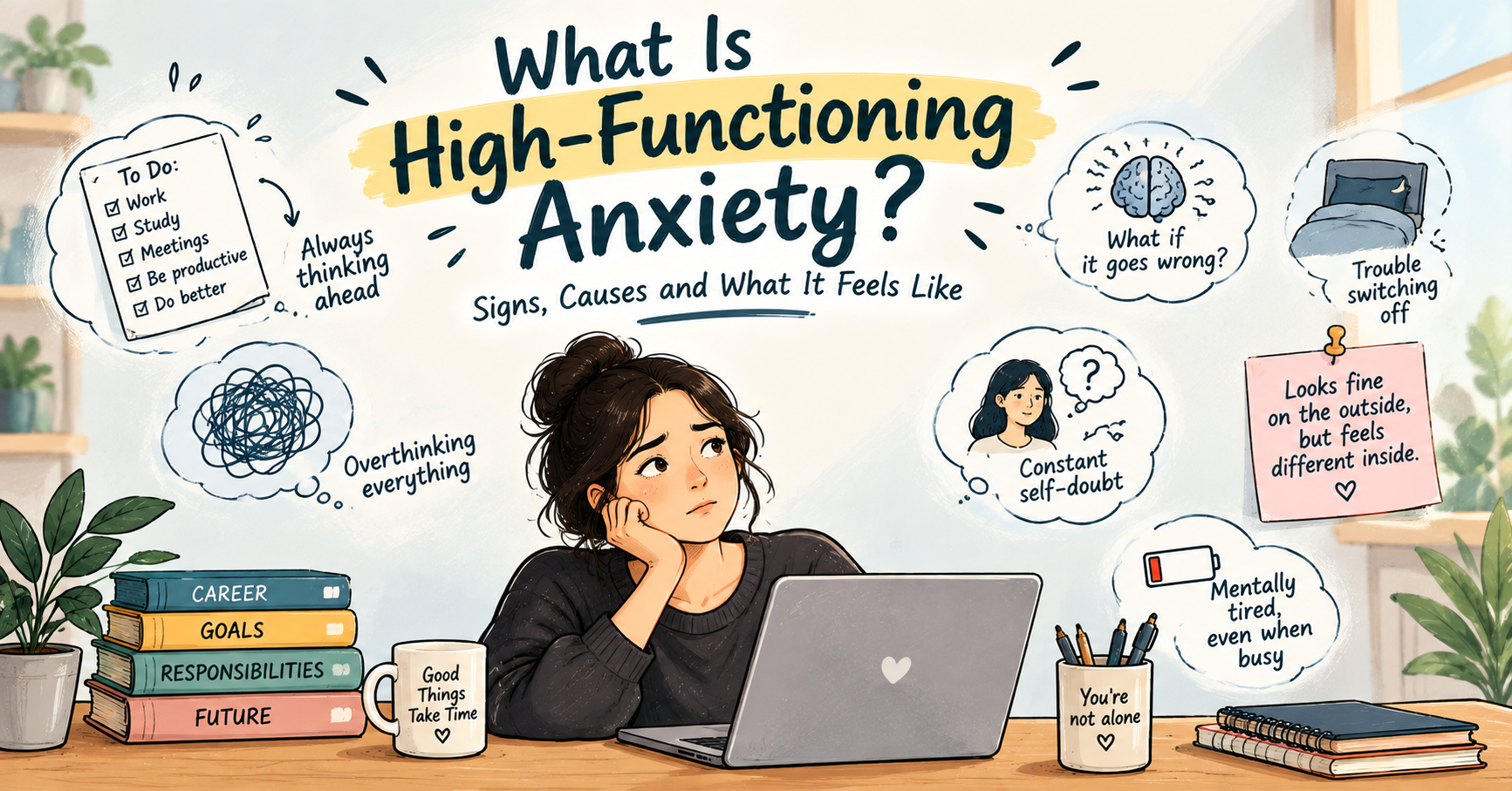

You get your work done. You reply to messages. You show up on time. You may even be the person everyone describes as organized, reliable, and successful.
But inside, things can feel very different.
Your mind may constantly run through what could go wrong. You might replay conversations, worry about making mistakes, struggle to relax, or feel like you always need to be doing something productive.
This is where the term high-functioning anxiety often comes up.
It is important to understand what the term actually means, because high-functioning anxiety is not a formal medical diagnosis. It is an informal phrase used to describe people who experience significant anxiety while still managing to keep up with work, school, relationships, and everyday responsibilities.
What Does High-Functioning Anxiety Mean?
Someone experiencing high-functioning anxiety may look perfectly fine from the outside.
They might have a successful career, maintain friendships, meet deadlines, exercise regularly, and appear confident. At the same time, they may spend much of their day dealing with worry, self-doubt, perfectionism, or an uncomfortable feeling that something is about to go wrong.
In other words, being productive does not necessarily mean that someone feels calm.
The phrase is sometimes used to describe people with symptoms associated with an anxiety disorder, including generalized anxiety disorder (GAD). GAD itself is a recognized mental health condition involving excessive and difficult-to-control worry that persists over time and affects daily life.
What Does High-Functioning Anxiety Feel Like?
Anxiety does not look the same for everyone.
For some people, it may feel like having a mind that never really switches off.
You finish one task and immediately start thinking about the next one. You receive a short message from someone and wonder whether you have done something wrong. You submit a piece of work and spend the next few hours thinking about what you could have done better.
Sometimes, the anxiety can actually push a person to achieve more.
You may prepare for something over and over because you are afraid of getting it wrong. You may arrive early because being late makes you uncomfortable. You may take on extra work because saying no feels difficult.
From the outside, these behaviors can look like dedication.
Inside, they can feel exhausting.
Common Signs of High-Functioning Anxiety
There is no official checklist for high-functioning anxiety, but people who use the term often describe patterns such as:
- Constant overthinking
- Worrying about small mistakes
- Expecting the worst outcome
- Perfectionism
- Difficulty saying no
- Needing reassurance
- Feeling uncomfortable when resting
- Constantly staying busy
- Trouble switching off after work
- Difficulty relaxing even when everything is going well
- Fear of disappointing other people
- Replaying conversations in your head
- Problems falling asleep because your mind is racing
- Physical tension, headaches, stomach problems, or a fast heartbeat
Many of these symptoms can also occur with recognized anxiety disorders. NIMH lists excessive worry, feeling restless or on edge, difficulty concentrating, fatigue, muscle tension, sleep problems, and several physical symptoms among the symptoms associated with GAD.
Having some of these experiences does not automatically mean you have an anxiety disorder.
Why Can High-Functioning Anxiety Be Difficult to Notice?
One of the biggest problems is that other people may not see it.
If someone is meeting deadlines and performing well at work, friends or colleagues may assume everything is fine.
The person experiencing the anxiety may also believe the same thing.
They might think:
"I'm just a perfectionist."
"I work better under pressure."
"Everyone worries this much."
"I'll relax once I finish everything."
But the list of things that need to be finished never seems to end.
UCLA Health notes that some people with anxiety can become so accustomed to their anxiety that they start viewing it as a necessary part of their success.
That can make it harder to recognize when worry has become a problem.
High-Functioning Anxiety vs. Normal Stress
Everyone experiences stress and occasional anxiety.
A difficult presentation, an upcoming exam, financial uncertainty, or an important interview can naturally make you nervous.
The difference is often how persistent the anxiety is and how much control it has over your life.
NIMH explains that occasional anxiety is a normal part of life. Anxiety disorders involve symptoms that do not simply disappear and can interfere with everyday activities.
For example, feeling nervous before a presentation is normal.
Spending days worrying about every possible mistake, losing sleep over it, and repeatedly imagining embarrassing yourself may be a sign that anxiety is becoming more significant.
Is High-Functioning Anxiety a Mental Health Disorder?
Not by itself.
High-functioning anxiety is not an official diagnosis. A mental health professional would instead look at the specific symptoms, how long they have been happening, how difficult they are to control, and how they affect your life. Depending on the situation, the symptoms could fit a recognized condition such as generalized anxiety disorder or another anxiety disorder.
This distinction matters because simply identifying with a social-media label cannot tell you whether you have a clinical condition.
How Can You Manage It?
The first step is usually noticing the pattern rather than judging yourself for it.
If you constantly feel the need to be productive, ask yourself what happens when you stop. Do you feel guilty? Restless? Worried that you are wasting time?
It can also help to build small periods of genuine downtime into your day.
A few useful habits include:
- Taking short breaks instead of working continuously
- Getting regular physical activity
- Protecting your sleep schedule
- Reducing excessive caffeine if it worsens your anxiety
- Writing down worries instead of repeatedly thinking about them
- Practicing slow breathing or mindfulness
- Spending time with people you feel comfortable around
- Setting realistic expectations instead of trying to do everything perfectly
These habits can support mental health, but they are not a substitute for professional treatment when anxiety is persistent or interfering with life. NIMH notes that healthy habits such as adequate sleep, reducing caffeine, exercise, mindfulness, and meditation may help alongside standard care.
When Should You Talk to Someone?
You do not have to wait until anxiety becomes unbearable before asking for help.
Consider talking to a doctor or mental health professional if worry is affecting your sleep, relationships, work, concentration, appetite, or ability to enjoy normal activities.
Treatment depends on the underlying problem. Psychotherapy, including cognitive behavioral therapy (CBT), is commonly used for anxiety disorders, and medication may also be appropriate for some people depending on their individual situation.
Most importantly, you do not have to look like you are struggling for your anxiety to be real.
Final Thoughts
High-functioning anxiety can be difficult to recognize precisely because the person experiencing it may appear to be doing well.
Being successful, organized, productive, or dependable does not mean you have to feel anxious all the time.
If your achievements are constantly being driven by fear of failure, excessive worry, or the feeling that you can never switch off, it may be worth taking a closer look at what is happening beneath the surface.
You don't need to diagnose yourself. Sometimes the most useful first step is simply admitting that "I'm managing" and "I'm feeling okay" are not always the same thing.