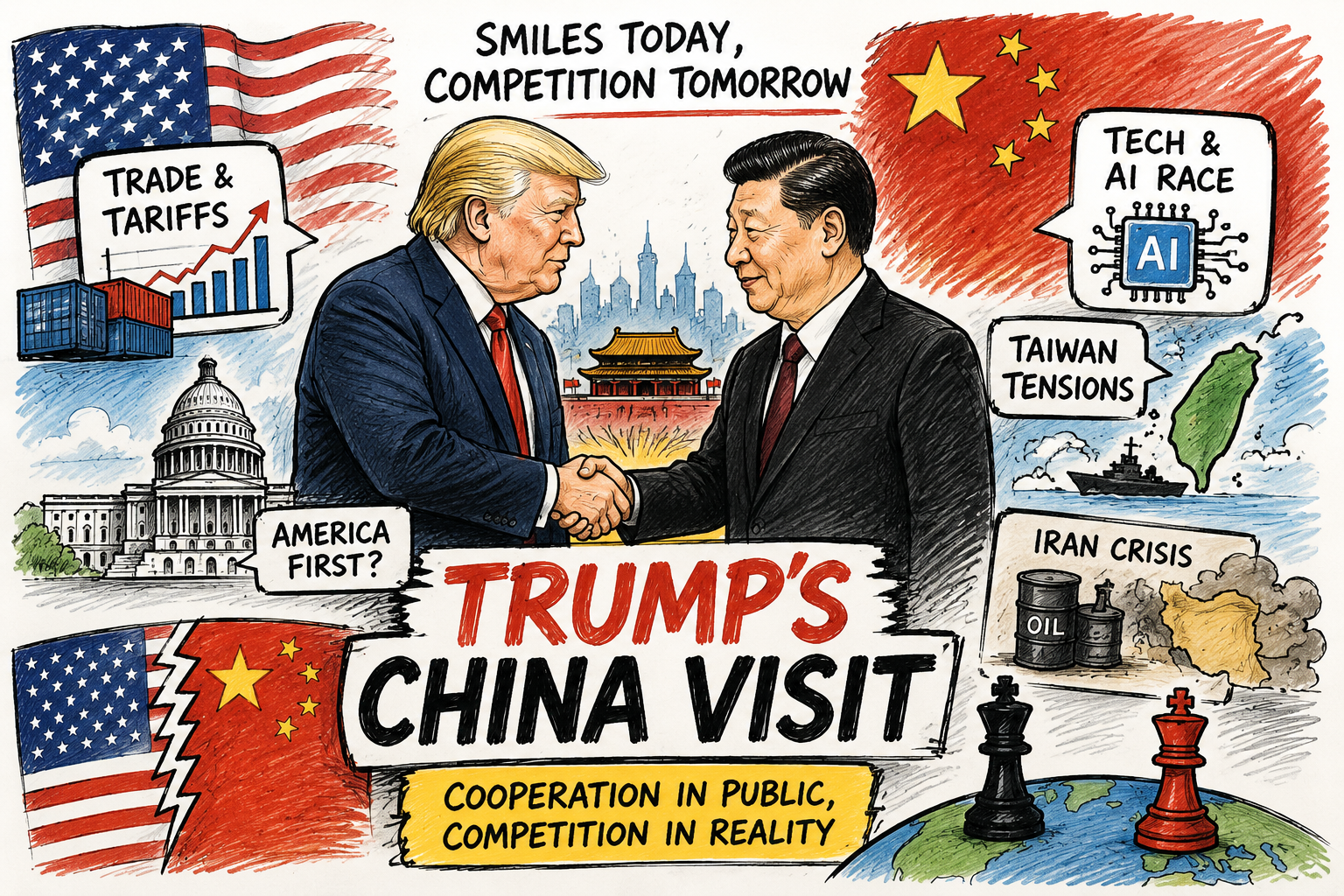

When Donald Trump landed in China this week for a high-profile summit with Xi Jinping, the world watched closely. It was the first visit by a sitting US president to China in nearly a decade, and, expectations were enormous.

Would the two biggest powers finally reduce tensions? Would there be breakthroughs on trade, Taiwan, AI, or the Iran crisis? Or was this simply political theatre wrapped in diplomatic smiles?
By the end of the two-day Beijing summit, one thing became clear: the US-China rivalry is entering a new phase-calmer in appearance, but deeper in strategic competition..
A Summit Designed for Global Optics
China welcomed Trump with extraordinary symbolism. There were military ceremonies, red carpets, children waving flags, and lavish state banquets inside Beijing’s Great Hall of the People. The imagery was deliberate: China wanted to project stability, confidence, and equal global status alongside the United States.
Trump repeatedly praised Xi during the visit, calling him a “great leader” and claiming the US-China relationship would become “better than ever.” Xi, meanwhile, emphasized that cooperation between both countries was essential for global stability.
The warmth was visible. But beneath the diplomatic language, serious disagreements remained unresolved.

The Real Issues Behind the Meeting
The summit revolved around four major geopolitical flashpoints:
- Trade and tariffs
- Taiwan
- Artificial Intelligence
- The Iran conflict
These are not minor policy disagreements. They represent the future balance of global power.
1. Trade Relations Still Remain Fragile
Trump claimed that “fantastic trade deals” had been discussed, including possible Chinese purchases of American agricultural products, oil, and Boeing aircraft.
However, no major agreement was officially announced.
That matters because the US-China trade relationship has become increasingly distrustful over the last decade. Washington accuses Beijing of unfair industrial practices and technological expansion, while China sees American restrictions as attempts to contain its rise.
The summit reduced tensions temporarily, but it did not solve the deeper economic rivalry.
Taiwan Remains the Most Dangerous Issue
One of the most sensitive parts of the summit involved Taiwan.
China warned the United States against expanding military cooperation or weapons sales to Taiwan. Beijing considers Taiwan part of its territory, while the US continues to maintain strategic support for the island.
Trump avoided directly challenging Xi during the summit, but he also avoided making concessions.

This strategic ambiguity shows how dangerous the Taiwan issue has become. Even a small military escalation in the region could trigger a global economic and security crisis.
The AI Race Is Becoming the New Cold War
Artificial Intelligence quietly became one of the biggest talking points of the trip.
Trump claimed Xi was “surprised” by America’s recent AI advances and insisted the US was now substantially ahead of China in the technology race.
This is significant because AI is no longer just a tech issue. It is now tied directly to:
- military power
- cybersecurity
- economic dominance
- surveillance systems
- global influence
The AI competition between Washington and Beijing increasingly resembles a modern Cold War — not based on nuclear weapons alone, but on technological supremacy.
Iran Added Urgency to the Summit
The ongoing Middle East crisis also shaped the discussions.
Both leaders reportedly discussed keeping the Strait of Hormuz open and preventing Iran from developing nuclear weapons.
This issue matters globally because any disruption in the region affects:
- oil prices
- shipping routes
- inflation
- global markets
For Trump, China’s influence over Iran could become strategically useful. For Xi, the Iran conflict also exposes growing American military pressure across multiple regions.
Why This Visit Matters for India
For India, the summit carries major implications.
India is carefully balancing relations with:
- the United States
- Russia
- China
- Gulf nations
If US-China tensions escalate further:
- supply chains could shift toward India
- global investment patterns may change
- regional security dynamics in Asia could become more unstable
India also closely watches the Taiwan issue because any conflict in East Asia would impact trade, semiconductors, and global economic growth.
In many ways, India could emerge as both a beneficiary and a strategic pressure point in this evolving rivalry.
A Friendly Summit Without Real Resolution
Despite the warm body language and positive statements, most analysts agree that the summit produced few concrete breakthroughs.
The visit was less about solving problems and more about managing tensions.
That itself reveals something important: both Washington and Beijing understand that direct confrontation would be disastrous. Yet neither side appears willing to compromise on the core issues shaping the 21st century.
The smiles in Beijing may have looked reassuring.
But underneath them, the struggle for global dominance continues.