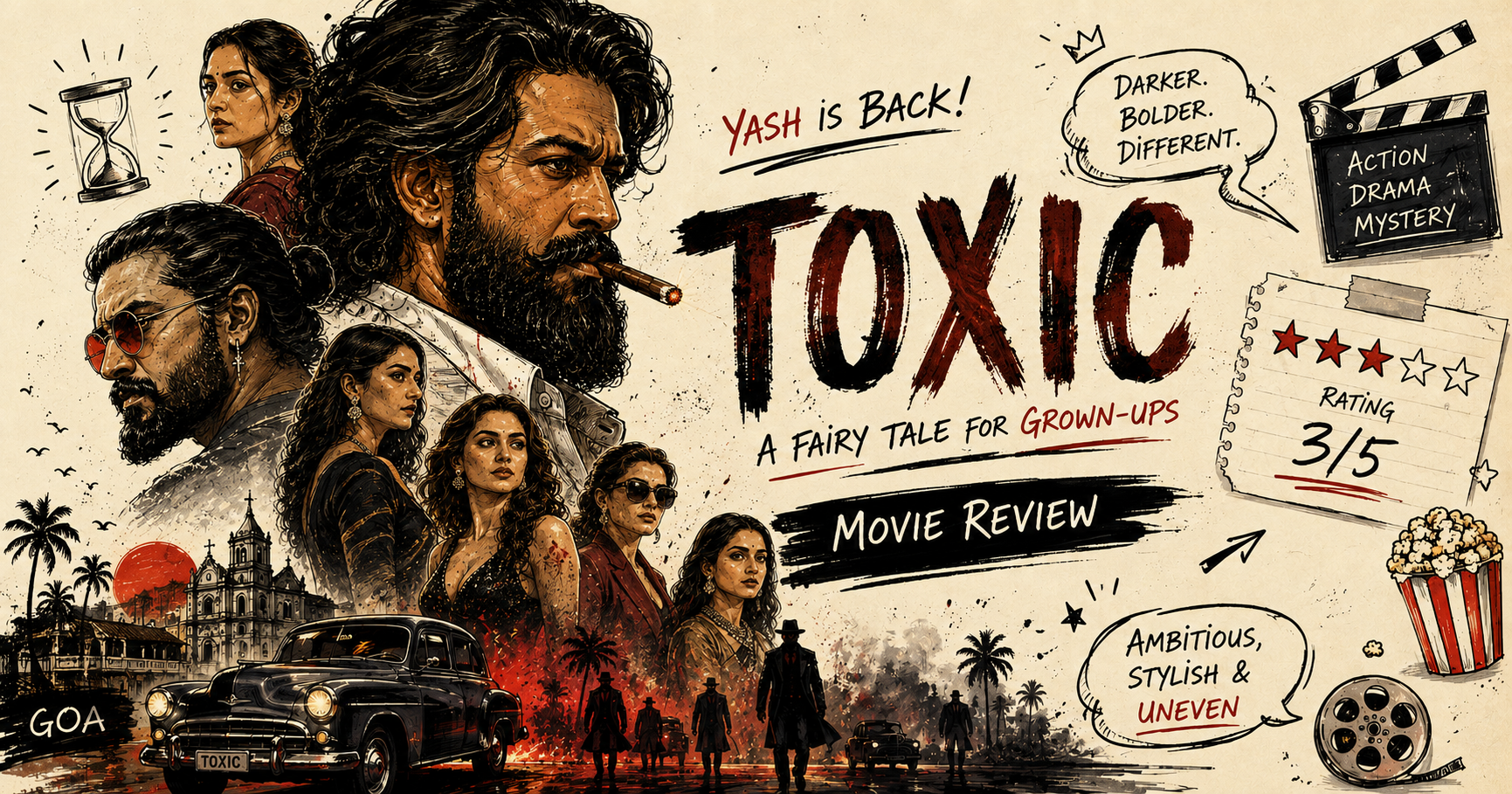

Rating: ★★★☆☆ (3/5)
After almost four years away from the big screen following the massive success of KGF: Chapter 2, Yash returns with Toxic: A Fairy Tale for Grown-Ups, a film that is very different from the straightforward mass entertainer many fans may have expected.
Directed by Geetu Mohandas, Toxic is a dark, violent and psychologically layered gangster drama that attempts to combine family conflict, crime, trauma and questions of identity into one large cinematic experience. It is also an ambitious film in almost every sense. The scale is big, the cast is impressive, the visuals are striking and Yash is given one of the most challenging roles of his career.
But ambition alone does not always create a great film.
Toxic has moments of brilliance, some powerful visuals and a commanding performance from Yash, yet its storytelling often struggles to match the strength of its presentation. The result is a film that is fascinating, frustrating and undeniably different.

A Story That Refuses to Be Simple
At its core, Toxic is built around Raya and Ticket, two characters played by Yash, whose relationship drives the emotional and psychological conflict of the story.
What initially appears to be a gangster drama gradually becomes something more complicated. The film explores trauma, fractured identity, violence and the blurred line between reality and perception. Its climax deliberately leaves room for interpretation, particularly regarding Ticket's existence and the nature of Raya's final journey.
This is where Geetu Mohandas deserves credit.
Toxic does not seem interested in giving the audience a conventional good-versus-evil story. It wants viewers to question what they are watching and whether everything happening on screen should be taken literally.
However, the film's biggest strength also becomes one of its biggest weaknesses.
The narrative is often so busy trying to be mysterious, stylish and unconventional that it sometimes loses emotional clarity. Certain moments feel deliberately cryptic without always delivering a satisfying payoff. The film's considerable runtime and pacing have also been among the major criticisms in early reviews.
Yash Carries Toxic on His Shoulders
If there is one reason Toxic remains engaging even during its weaker stretches, it is Yash.
This is not simply another version of Rocky from KGF.
Yash gets an opportunity to explore a more complicated emotional space here. His performance has the charisma and screen presence audiences expect from him, but the dual-role structure also allows him to experiment with vulnerability, anger and psychological instability.
The contrast between Raya and Ticket gives him more to work with than a typical larger-than-life action hero role. Even critics who were dissatisfied with the film itself have highlighted Yash as one of its strongest elements.
His screen presence remains enormous, and Toxic once again proves that Yash understands how to command an audience without constantly relying on dialogue or exaggerated hero moments.
There are scenes where a look, a pause or a change in expression does more work than pages of dialogue.
For Yash fans, this is easily one of the biggest reasons to watch the film.
The Supporting Cast Has Presence, but Not Always Enough Space
Toxic brings together a major ensemble including Kiara Advani, Nayanthara, Huma Qureshi, Tara Sutaria and Rukmini Vasanth.

On paper, this is an incredibly exciting lineup.
The problem is that a large cast does not automatically mean every character receives equal development. Some characters make an impact through their presence and performance, while others feel like they deserved stronger writing and more meaningful involvement in the central narrative.
This has been part of the discussion surrounding the film's reception, with criticism directed toward character development and the limited narrative importance given to some members of the female ensemble.
The performances are not necessarily the problem.
The issue is that Toxic occasionally feels more interested in its central mystery and visual atmosphere than in fully exploring everyone inhabiting its world.
Geetu Mohandas Creates a Dark and Distinctive World
Visually, Toxic is one of the film's strongest aspects.
The atmosphere is grim, stylish and deliberately unsettling. Geetu Mohandas tries to create a world that feels less like a traditional commercial gangster film and more like a psychological nightmare wrapped inside a larger-than-life spectacle.
The production design, action and visual presentation have received praise even from viewers who found the story divisive.
There is clearly an attempt to move away from the formula that has dominated many recent pan-Indian blockbusters.
Toxic does not simply want to give audiences a hero introduction, a series of action sequences and an obvious emotional payoff. It wants to be stranger and darker.
Whether that approach works will depend heavily on the viewer.
Some audiences may appreciate its willingness to take risks.
Others may find the film exhausting.
The Biggest Problem Is the Pacing
Toxic has enough material for an engaging psychological gangster drama, but it does not always know when to slow down or when to move forward.
The film's runtime has been a significant point of criticism, with reviews noting that the narrative can feel stretched and that the pacing affects the overall impact.
There are sequences that look impressive but feel longer than necessary. Some emotional moments arrive without enough buildup, while certain ideas are introduced and then not explored as deeply as they could have been.
A tighter edit could have made a major difference.
The film often feels like it has several competing identities:
- A gangster saga
- A family drama
- A psychological thriller
- A story about trauma
- A surreal mystery
- A large-scale action spectacle
Each of these ideas is interesting individually.
Putting all of them together, however, creates a film that occasionally feels overloaded.
Action and Mature Content

The action sequences provide some of the film's most immediately entertaining moments, while the overall presentation gives Toxic the scale expected from a major Yash release.
However, the film's adult content has also generated considerable discussion. Toxic received an Adults Only certification, and some viewers have questioned whether certain intimate scenes contribute meaningfully to the narrative.
That makes the title A Fairy Tale for Grown-Ups more than just a marketing line.
This is clearly not designed as a family entertainer.
The film deals with violence, disturbing themes and mature situations, and viewers expecting another KGF-style mass film should be prepared for a noticeably different experience.
The Ending Will Divide Audiences
Without giving away the complete resolution, the ending is probably the most interesting part of Toxic.
The final confrontation and the ambiguity surrounding Raya and Ticket transform the story from a relatively familiar conflict into something much more psychological. The film intentionally leaves viewers questioning what was real, what was imagined and what the final moments truly mean.
Some viewers will love this ambiguity.
Others may leave the theatre feeling that the film has complicated things unnecessarily.
But at least the ending gives audiences something to discuss, and that is more than can be said for many formula-driven blockbusters.
Final Verdict: Ambitious, Stylish and Flawed
Toxic: A Fairy Tale for Grown-Ups is not a perfect comeback film for Yash.
It is too long, unevenly paced and occasionally overwhelmed by its own ambition. Some characters deserved more development, and the screenplay does not always deliver the emotional impact its themes demand.
Yet, it is difficult to dismiss the film completely.
Yash gives the film a powerful centre, the visual world is distinctive and Geetu Mohandas deserves credit for attempting something unconventional on such a massive scale. Early critical and audience reactions have reflected this divide, with praise for Yash's performance, visuals and action alongside significant criticism of the pacing and storytelling.
Toxic is ultimately the kind of film that will create two very different reactions.
Some will see it as a bold attempt to break away from the predictable pan-Indian blockbuster formula.
Others will see it as a stylish film that loses itself in its own complexity.
For me, it falls somewhere in between.
It is not the explosive, universally satisfying spectacle that KGF was. But it is also more ambitious and unusual than a routine star vehicle. Toxic takes risks, and while not all of them work, the attempt itself makes the film worth discussing.
Should You Watch Toxic?
Watch it if:
- You are a Yash fan.
- You enjoy dark and psychological gangster dramas.
- You appreciate ambiguous storytelling.
- You want to see Yash in a different kind of role.
- You are open to a slow and unconventional narrative.
You may want to skip it if:
- You expect another KGF-style mass entertainer.
- You prefer fast-paced, straightforward storytelling.
- You dislike ambiguous endings.
- You are looking for a family-friendly film.
Bubble Blog Rating: ★★★☆☆
3/5
Toxic is bold, visually striking and powered by Yash's presence, but its excessive runtime and uneven storytelling stop it from becoming the unforgettable cinematic experience it clearly wants to be. It may not work for everyone, but one thing is certain: Toxic is unlikely to leave audiences indifferent.