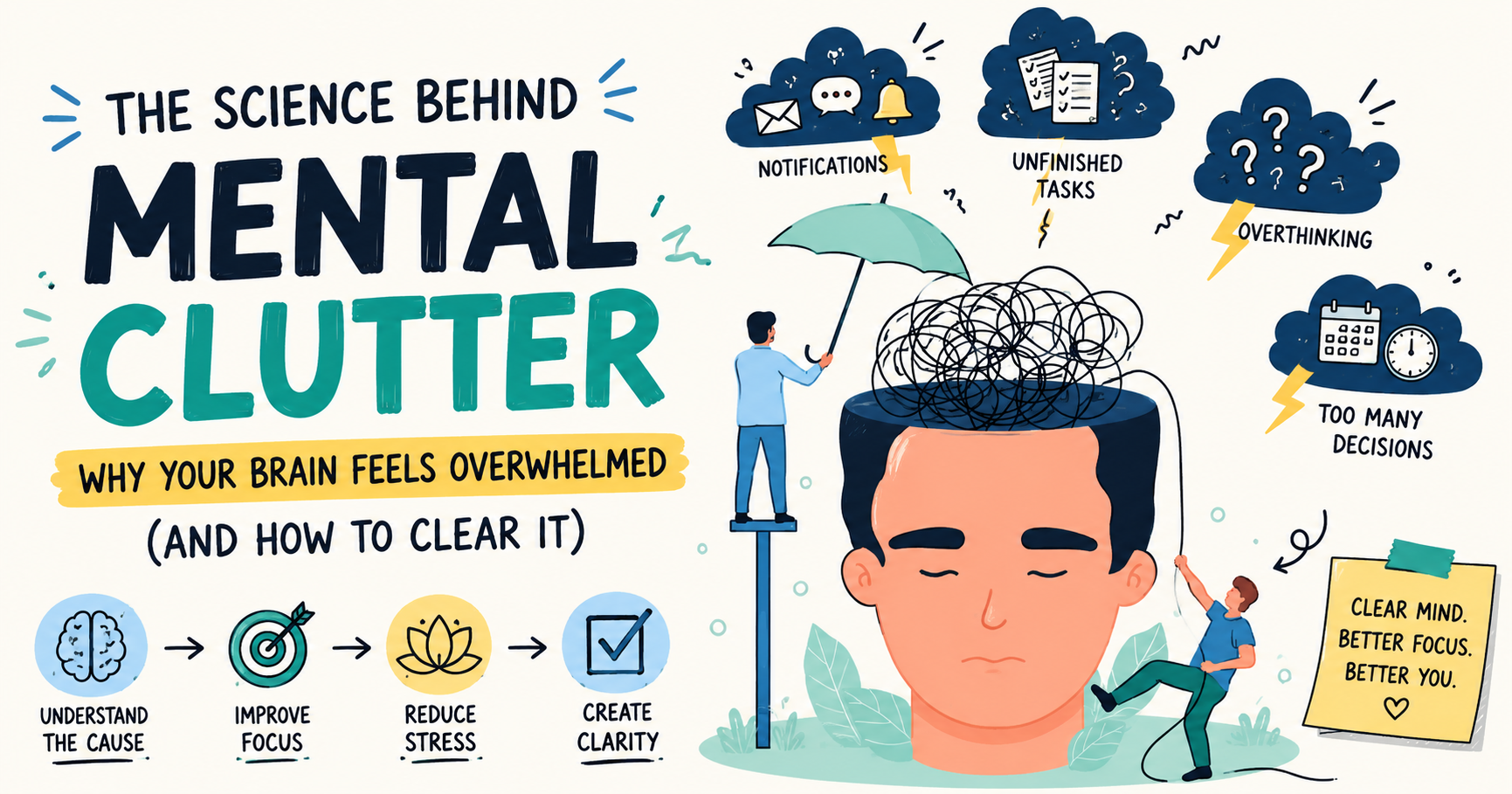

Have you ever sat down to work, only to find yourself thinking about five different things at once? Maybe you're remembering an email you forgot to send, worrying about tomorrow's meeting, planning dinner, and wondering if you should finally organize your closet—all before you've even started your first task.
If that sounds familiar, you're not alone.
Many people describe this feeling as having "too much on their mind." While mental clutter isn't a medical diagnosis, psychologists and neuroscientists have studied the cognitive processes behind this overwhelming sensation for decades.
The good news? Once you understand the science behind mental clutter, it becomes much easier to manage. In this article, we'll look at why your brain feels overloaded, what causes mental clutter, and practical ways to regain focus and mental clarity.
What Is Mental Clutter?

Mental clutter refers to an overload of thoughts, worries, reminders, decisions, and information competing for your attention at the same time.
Imagine opening dozens of browser tabs on your computer. Eventually, everything slows down. Your brain works in a similar way. While it can process an incredible amount of information, it also has limits. When those limits are exceeded, concentrating, making decisions, and remembering things become much harder.
Unlike a mental health condition, mental clutter is a common experience that can affect anyone—especially in today's fast-paced, digitally connected world.
The Science Behind Mental Clutter
So why does your brain become overwhelmed so easily? Several well-known psychological and neurological concepts help explain what's happening behind the scenes.
Your Brain Has Limited Working Memory
One of the biggest reasons for mental clutter is the limited capacity of working memory.
Working memory is the part of your brain that temporarily stores and processes information needed for everyday tasks. Whether you're solving a problem, remembering directions, or following a conversation, you're using working memory.
However, it can only hold a small amount of information at once.
When you try to juggle multiple tasks, conversations, reminders, and worries simultaneously, your brain begins dropping information or constantly switching attention between thoughts.
That's why multitasking often leaves you feeling mentally exhausted rather than productive.
Information Overload Is Everywhere
Modern life constantly competes for your attention.
Think about how much information you consume in a single day:
- Emails
- Text messages
- Social media notifications
- News headlines
- Work chats
- Calendar reminders
- Streaming recommendations
- Online shopping ads
Your brain wasn't designed to process this much input continuously.
Every notification asks your brain to pause what it's doing, evaluate new information, and decide whether it deserves attention. Over time, these constant interruptions create cognitive overload, making it harder to focus on meaningful tasks.
Decision Fatigue Slowly Drains Your Mental Energy
Have you ever noticed that making simple decisions feels harder by the end of the day?
That's because every choice uses a small amount of mental energy.
From deciding what to wear and what to eat to responding to emails and prioritizing work, your brain is constantly making decisions.
This phenomenon is known as decision fatigue.
As your mental energy decreases throughout the day, your ability to make thoughtful decisions also declines. That's why many successful people simplify routine choices—such as wearing similar outfits or following structured schedules—to preserve mental energy for more important decisions.
The Zeigarnik Effect Keeps Unfinished Tasks Alive
Have you ever remembered an unfinished task just as you're trying to fall asleep?
There's a psychological explanation for that.
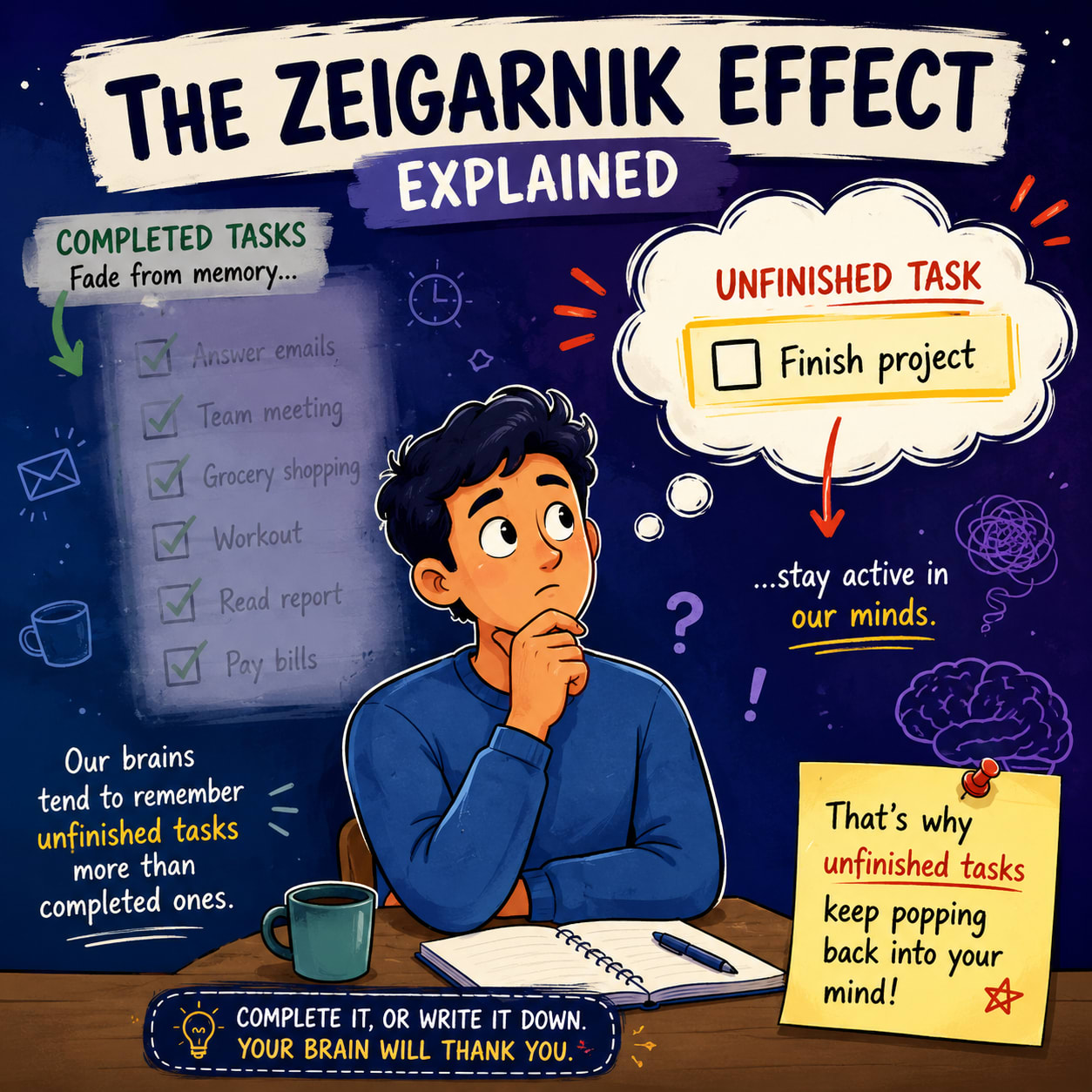
The Zeigarnik Effect suggests that people remember incomplete tasks more vividly than completed ones.
Your brain treats unfinished work like an open loop that still requires attention.
Whether it's a report you haven't finished, a phone call you forgot to make, or laundry waiting to be folded, these incomplete tasks continue occupying mental space until they're completed or written down.
That's one reason a simple to-do list can feel surprisingly calming—it reassures your brain that the task won't be forgotten.
Stress Makes Mental Clutter Worse
Stress and mental clutter often feed into each other.
When you're under pressure, your body releases stress hormones that prepare you to respond to challenges. While this response can be helpful in short bursts, ongoing stress makes it harder to concentrate, organize thoughts, and solve problems efficiently.
Instead of focusing on one priority, your brain starts scanning for every possible concern at once.
The result?
Even small tasks begin to feel overwhelming.
Signs Your Mind Is Mentally Cluttered

Mental clutter looks different for everyone, but some common signs include:
- Constant overthinking
- Difficulty concentrating
- Forgetting simple tasks
- Feeling mentally exhausted despite doing little physical work
- Jumping between multiple tasks without finishing them
- Trouble relaxing during free time
- Difficulty making decisions
- Feeling overwhelmed by small responsibilities
- Poor sleep because your mind won't slow down
If several of these sound familiar, your brain may simply be overloaded with competing thoughts rather than lacking motivation.
How to Reduce Mental Clutter (Backed by Psychology)
The good news is that mental clutter can often be reduced with small, consistent habits.
1. Try a Brain Dump
Instead of trying to remember everything, write it down.
Spend five minutes listing every task, idea, worry, or reminder that's occupying your mind.
This technique frees up mental space because your brain no longer has to keep everything in active memory.
2. Focus on One Task at a Time
Despite popular belief, multitasking usually reduces efficiency.
Switching between tasks forces your brain to repeatedly adjust its focus, which increases mental fatigue.
Choose one important task, finish it, and then move on to the next.
3. Reduce Digital Noise
Your phone is often the biggest source of mental clutter.
Consider:
- Turning off unnecessary notifications
- Limiting social media scrolling
- Checking email at scheduled times
- Keeping your workspace free from digital distractions
Fewer interruptions allow your brain to stay focused for longer periods.
4. Use Time Blocking
Instead of constantly deciding what to do next, assign specific blocks of time to different activities.
For example:
- 9:00–10:30 — Deep work
- 10:30–10:45 — Break
- 10:45–12:00 — Meetings
- 1:00–2:00 — Emails
This simple structure reduces decision fatigue and improves concentration.
5. Prioritize Sleep
Sleep is one of your brain's most important maintenance tools.
During quality sleep, your brain consolidates memories, removes unnecessary information, and prepares for the next day.
Even one poor night's sleep can make mental clutter feel significantly worse.
6. Move Your Body
Physical activity benefits your brain as much as your body.
Whether it's walking, stretching, cycling, or strength training, regular exercise helps reduce stress and supports healthy cognitive function.
Even a 20-minute walk can improve mental clarity.
7. Practice Mindfulness
Mindfulness doesn't require sitting cross-legged for an hour.
Simply taking a few slow breaths or paying attention to the present moment can interrupt cycles of overthinking and help your brain reset.
Consistency matters more than duration.
Everyday Habits That Quiet Your Mind
Small habits often make the biggest difference over time.
Try incorporating these into your routine:
- Keep a simple daily to-do list.
- Declutter your workspace.
- Avoid checking your phone immediately after waking up.
- Read a book instead of endlessly scrolling before bed.
- Take short breaks between focused work sessions.
- Spend a few minutes outdoors each day.
- Set realistic priorities instead of trying to do everything at once.
These habits create more mental space and make it easier to focus on what truly matters.
Can Mental Clutter Affect Productivity?
Absolutely.
When your brain is overloaded, even simple tasks can feel difficult.
Mental clutter can lead to:
- Slower decision-making
- Reduced creativity
- More mistakes
- Lower motivation
- Difficulty completing projects
- Constant procrastination
Clearing mental clutter doesn't mean becoming perfectly organized—it means giving your brain enough breathing room to focus on the task in front of you.
The Bottom Line
Mental clutter is one of the hidden challenges of modern life. Between endless notifications, unfinished tasks, constant decisions, and information overload, it's no surprise that many people feel mentally exhausted before the day is even over.
The encouraging news is that your brain isn't designed to hold everything at once—and it doesn't have to. Simple habits like writing things down, limiting distractions, getting enough sleep, and focusing on one task at a time can make a noticeable difference.
Understanding the science behind mental clutter isn't about achieving a perfectly empty mind. It's about creating enough mental space to think clearly, make better decisions, and enjoy the present moment without feeling constantly overwhelmed.