
Have you ever finished a difficult task and felt a sense of satisfaction?
Or felt calmer after spending time with someone you trust?
Maybe you've experienced a mood boost after exercise, laughter, music, or achieving something you had been working toward.
These experiences are often explained online through the idea of “happiness hormones.”
The term is catchy, but the science is more interesting than a simple list of chemicals that switch happiness on and off.
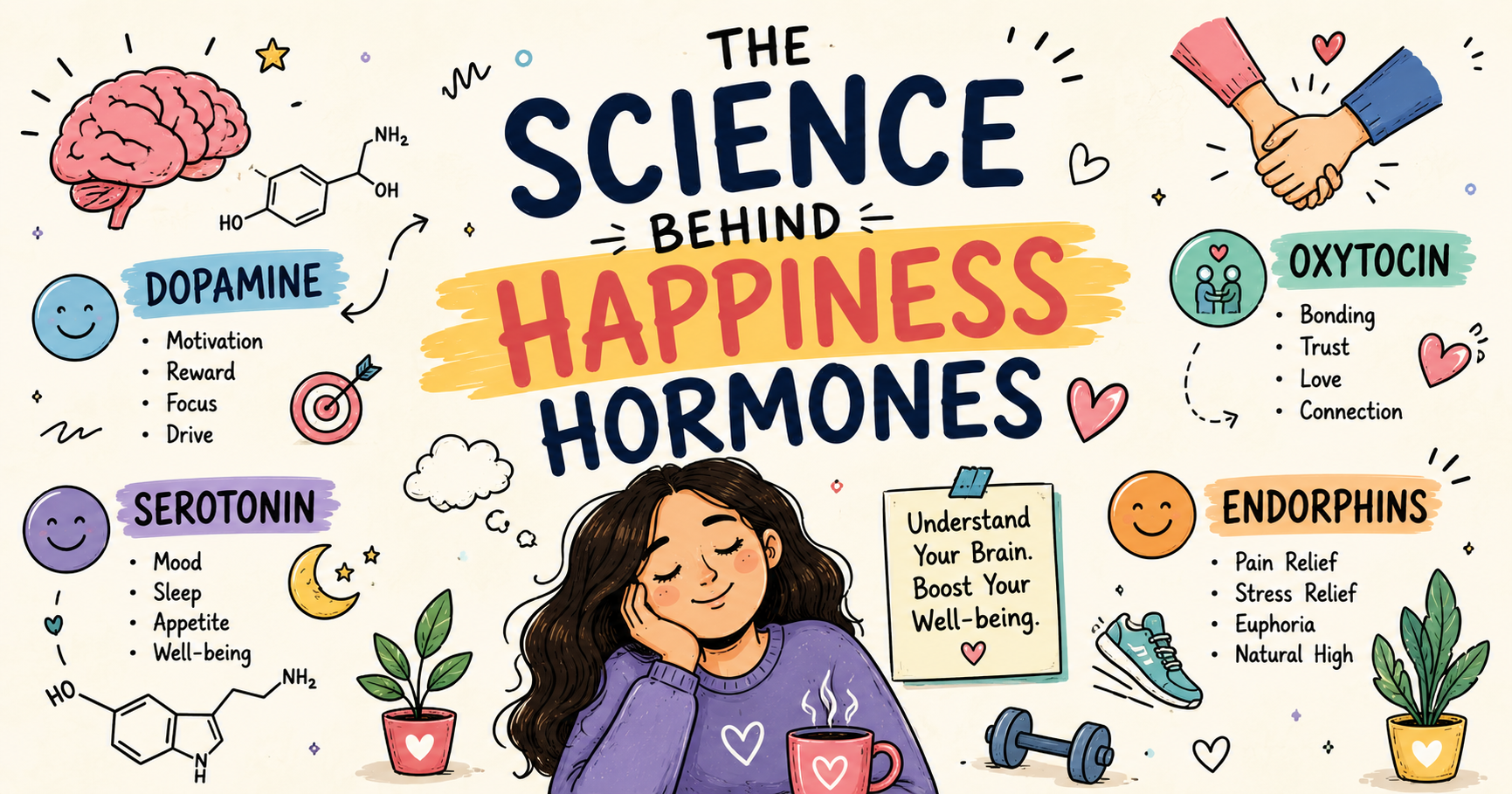
Dopamine, serotonin, oxytocin, and endorphins are all involved in different aspects of brain function, emotion, motivation, reward, social behavior, pain, and well-being. However, they do not act as four separate “happy buttons.” Happiness and well-being emerge from complex interactions between brain circuits, biology, experiences, relationships, environment, and many other factors.
So, what do these so-called happiness chemicals actually do?
Let's break down the science.
What Are “Happiness Hormones”?
The phrase “happiness hormones” is not a formal scientific category.
It is commonly used to describe several chemicals associated with positive emotions and well-being, particularly:
- Dopamine
- Serotonin
- Oxytocin
- Endorphins
But these substances are not all technically the same thing.
Dopamine and serotonin are primarily known as neurotransmitters, oxytocin is a neuropeptide and hormone, and endorphins are endogenous opioid peptides. Each has multiple functions throughout the brain and body.
That means calling dopamine simply the “pleasure chemical” or oxytocin simply the “love hormone” is an oversimplification.
Still, understanding their general roles can help explain why certain experiences can influence how we feel.
1. Dopamine: The Motivation and Reward Chemical
Dopamine is probably the most famous chemical on the “happiness hormones” list.
It is often called the reward chemical, but dopamine does much more than simply create happiness.
Dopamine plays important roles in:
- Motivation
- Reward-related behavior
- Learning
- Reinforcement
- Movement
- Emotion
- Executive functions
Dopamine signaling is especially important when the brain processes rewarding or motivationally relevant experiences.
A simple example
Imagine that you've been working on an important project for weeks.
Finally, you complete it.
That feeling of achievement can reinforce the behavior and increase your motivation to pursue future goals.
This is one reason dopamine is more accurately connected with motivation, learning, and reward processing, rather than simply being a chemical that “makes you happy.”
Everyday activities linked with reward and motivation
You may experience rewarding feelings when you:
- Complete a goal
- Learn something new
- Make progress on a project
- Receive positive feedback
- Enjoy food
- Listen to music you love
- Participate in enjoyable activities
The important thing is not to constantly chase bigger and bigger “dopamine hits.”
A healthier approach is to build meaningful rewards and achievable goals into everyday life.
2. Serotonin: A Chemical Involved in Mood and Much More
Serotonin is another chemical frequently called a “happiness hormone.”
Like dopamine, this label is incomplete.
Serotonin is a neurotransmitter involved in multiple processes, including:
- Mood regulation
- Sleep and wakefulness
- Appetite
- Gastrointestinal function
- Neural signaling
Many medications used in psychiatry also act on serotonin systems, although the biology of mood disorders is far more complex than simply having “low serotonin.”
This is important because one of the biggest myths online is:
“Depression is simply caused by a lack of serotonin.”
Mental health conditions are complex and can involve biological, psychological, social, and environmental factors. Serotonin is one part of a much larger picture.
Can you naturally “boost serotonin”?
Online articles often promise to dramatically increase serotonin with a particular food or supplement.
Be skeptical of simple claims like that.
There is no guaranteed lifestyle trick that allows you to directly control brain serotonin levels on demand.
However, healthy lifestyle habits such as regular physical activity, adequate sleep, nutritious eating, and social connection can support overall physical and mental well-being.
The goal should be supporting your overall health, not obsessively trying to manipulate individual brain chemicals.
3. Oxytocin: The Chemical Associated With Social Connection
Oxytocin is often called the “love hormone” or “bonding hormone.”
Again, those names are simplified, but they point toward an important part of its role.
Oxytocin is involved in a range of social and biological processes, including:
- Social behavior
- Attachment
- Bonding
- Parental behavior
- Reproductive functions
Research also shows that oxytocin interacts with dopamine pathways involved in motivation and reward, highlighting how closely these systems can work together.
Why social connection matters
Humans are social creatures.
Spending time with people you trust, feeling supported, sharing positive experiences, and maintaining meaningful relationships can all contribute to well-being.
This doesn't mean every hug produces a predictable dose of happiness.
Human relationships are much more complicated than that.
But strong social connections are an important part of psychological well-being, and oxytocin is one of the biological systems involved in social behavior.
Simple ways to support connection
- Spend time with friends or family
- Have meaningful conversations
- Show appreciation
- Participate in group activities
- Offer or receive appropriate physical affection
- Spend quality time with people you trust
4. Endorphins: The Body's Natural Pain-Modulating Chemicals
Endorphins are endogenous opioid peptides, meaning they are naturally produced by the body and interact with opioid receptors.
They are involved in processes including:
- Pain modulation
- Stress responses
- Reward
- Social behavior
Their effects are complex and depend on context.
You may have heard about the famous “runner's high.”
Exercise can produce positive changes in mood, but it is overly simplistic to say that this happens only because of endorphins. Other systems, including endocannabinoid pathways, may also contribute.
So yes, endorphins matter, but the brain rarely has just one chemical explanation for a particular feeling.
Happiness Is More Than Four Chemicals
It would be convenient if happiness worked like this:
Need happiness? Increase dopamine.
Unfortunately, the brain is much more complicated.
Researchers studying pleasure and well-being emphasize that reducing complex emotional experiences to one chemical can create misleading myths.
For example:
- Dopamine is not simply “happiness.”
- Serotonin is not a simple happiness meter.
- Oxytocin is not a magical “love chemical.”
- Endorphins are not a guaranteed source of euphoria.
Different brain systems interact with each other, and the same chemical can have different effects depending on the brain region, situation, and individual.
Happiness itself also has multiple dimensions.
You might experience:
Pleasure
Enjoying a delicious meal, music, or a beautiful sunset.
Engagement
Becoming deeply involved in something meaningful or challenging.
Connection
Feeling close to other people.
Accomplishment
Achieving something you've worked toward.
Meaning
Feeling that your life or actions matter.
A good life isn't simply about maximizing pleasure all the time.
Well-being can also involve purpose, relationships, growth, and resilience.
7 Practical Ways to Support Your Mood and Well-Being
Instead of searching for a magical way to “hack your happiness hormones,” focus on habits that support your physical and mental health.
1. Move Your Body Regularly
Physical activity can benefit both physical and mental health.
You do not need to become a marathon runner.
Try:
- Walking
- Cycling
- Dancing
- Yoga
- Strength training
- Swimming
- Playing a sport
The best activity is often one you actually enjoy enough to continue doing.
2. Set Small, Achievable Goals
Completing a meaningful task can create a sense of progress and accomplishment.
Instead of creating a massive to-do list, choose one realistic goal.
For example:
Instead of: “I need to completely transform my life.”
Try:
“I'll spend 20 minutes working on this project today.”
Small wins can help build momentum.
3. Prioritize Meaningful Social Connection
Send a message to a friend.
Call a family member.
Meet someone for coffee.
Have a conversation without constantly checking your phone.
Social connection is not a replacement for professional mental-health care, but supportive relationships can be an important part of well-being.
4. Protect Your Sleep
Sleep affects much more than how tired you feel.
Poor or insufficient sleep can affect mood, attention, emotional regulation, and overall functioning.
A simple starting point is to maintain a reasonably consistent sleep schedule and give yourself enough opportunity for sleep.
This is also a useful internal linking opportunity for your article on Sleep Myths You Should Stop Believing.
5. Spend Time on Activities You Genuinely Enjoy
Not everything has to be productive.
You might enjoy:
- Reading
- Cooking
- Gaming
- Gardening
- Drawing
- Music
- Photography
- Watching a favorite film
- Spending time outdoors
Enjoyment is a valid reason to do something.
You don't need to turn every hobby into a side hustle.
6. Get Outside When You Can
A walk outdoors can combine several potentially beneficial factors:
- Physical activity
- Exposure to daylight
- A change of environment
- Time away from screens
- Possible social interaction
Even a short walk can be a useful break during a busy day.
7. Practice Gratitude Without Forcing Positivity
Gratitude practices may help some people focus more intentionally on positive experiences.
Try writing down:
- Something you enjoyed today
- Someone you appreciate
- Something you are looking forward to
But don't use gratitude as a way to deny genuine problems or difficult emotions.
You can be grateful for something and still have a difficult day.
Both can be true.
A Simple “Feel-Good” Daily Routine
You do not need to follow a complicated wellness routine.
Try something like this:
Time of DaySimple HabitMorningGet some daylight and set one realistic goalAfternoonTake a short walk or move your bodyDuring the dayHave a meaningful conversationEveningSpend time doing something you genuinely enjoyBefore bedReduce unnecessary stimulation and prepare for sleep
The goal is not to “maximize happiness” every hour.
It is to create a lifestyle with more opportunities for movement, connection, rest, enjoyment, and meaning.
Common Myths About Happiness Hormones
Myth 1: Dopamine is the happiness chemical
Reality: Dopamine plays a major role in reward, motivation, learning, and other brain functions. It cannot be reduced to a simple happiness chemical.
Myth 2: You can instantly fix your mood by boosting serotonin
Reality: Serotonin is involved in mood and many other biological processes, but emotional well-being is influenced by far more than one chemical.
Myth 3: Oxytocin makes everyone trust and love each other
Reality: Oxytocin plays an important role in social processes, but its effects are context-dependent and much more complex than simply creating love or trust.
Myth 4: Endorphins are the only reason exercise improves your mood
Reality: Exercise affects multiple biological and psychological systems. Endorphins may contribute, but they are not the entire explanation.
Can You Increase Happiness Hormones Naturally?
The better question is:
How can I build habits that support my overall mood and well-being?
You cannot precisely control your brain chemistry with a single food, supplement, workout, or “dopamine detox.”
But you can support your health through consistent habits such as:
- Regular physical activity
- Adequate sleep
- Nutritious eating
- Meaningful relationships
- Time outdoors
- Enjoyable hobbies
- Realistic goals
- Stress-management practices
These habits do not guarantee constant happiness.
Nobody feels happy all the time.
And that shouldn't be the goal.
A healthy emotional life includes a range of feelings, including disappointment, frustration, sadness, excitement, contentment, and joy.
When Happiness Feels Difficult
Feeling unhappy, stressed, or unmotivated from time to time is part of being human.
But if low mood, loss of interest, hopelessness, anxiety, or emotional distress is persistent or interfering with your daily life, don't assume that you simply need to “boost your happiness hormones.”
Mental-health concerns deserve proper support and assessment.
Speaking with a qualified mental-health professional can be an important step when symptoms are persistent or difficult to manage.
The Bottom Line
Dopamine, serotonin, oxytocin, and endorphins all play fascinating roles in the biology of emotion, motivation, reward, pain, and social behavior.
But the idea that there are four simple “happiness hormones” that can be switched on whenever you feel sad is more myth than science.
Happiness and well-being come from a complex interaction between the brain, body, experiences, relationships, environment, and individual circumstances.
Instead of trying to chase a constant chemical high, focus on habits that make life healthier and more meaningful:
Move your body.
Sleep well.
Connect with people.
Set meaningful goals.
Make time for things you enjoy.
Allow yourself to experience the full range of human emotions.
That may not be a viral “happiness hack.”
But it is much closer to what the science actually suggests.