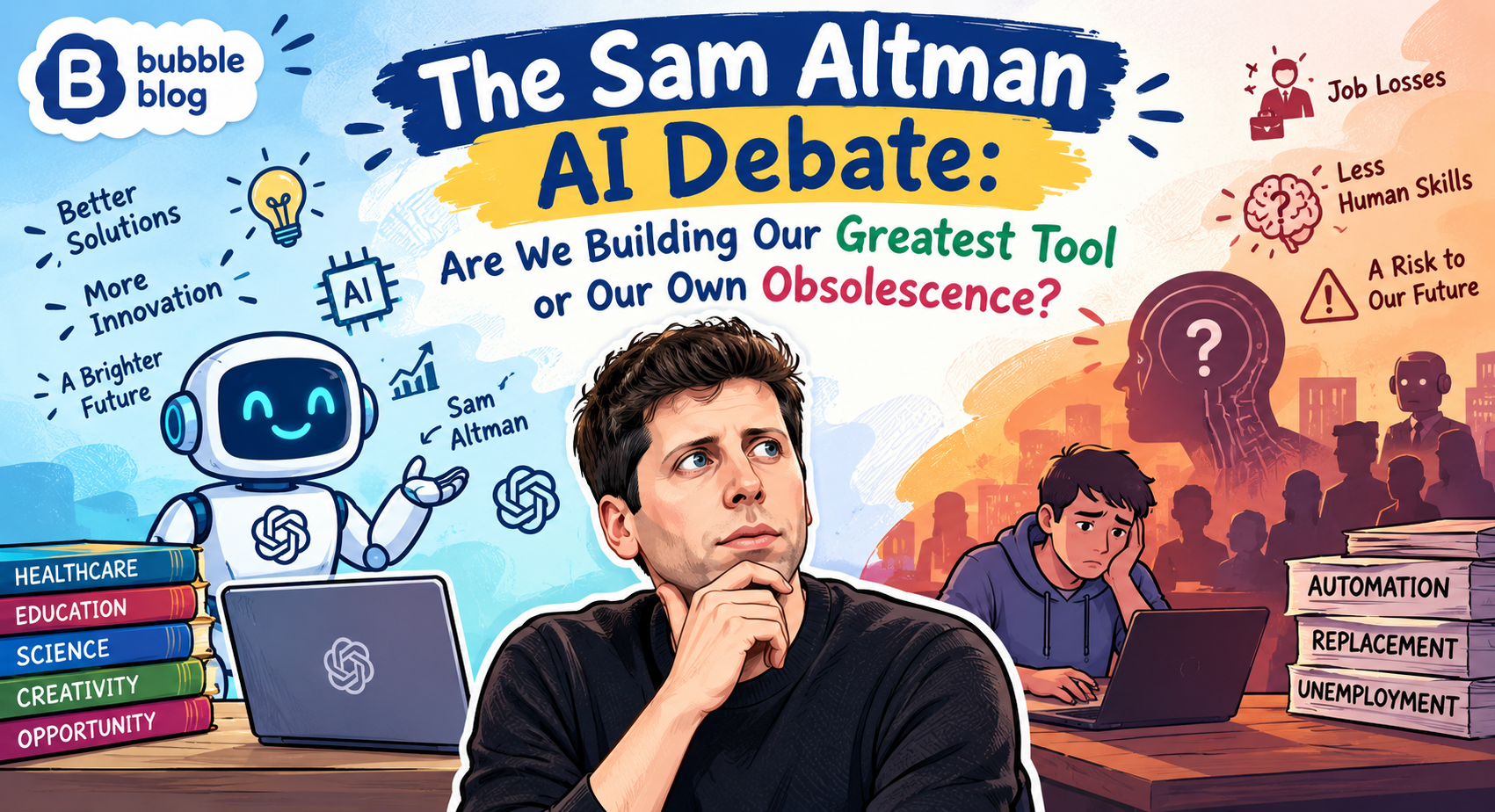

Artificial Intelligence has officially moved out of tech laboratories and science fiction novels into the center of global boardrooms, policy discussions, and dinner table debates. At the epicenter of this massive shift stands Sam Altman, the face of modern AI development. But as models grow smarter, faster, and more autonomous, a fierce debate surrounds him and the industry as a whole: Are we accelerating toward a golden age of human prosperity, or are we sleepwalking into a technological trap?To understand the weight of this debate, we have to look past the hype and examine the two colliding worldviews shaping our future.
The Promise of Infinite Abundance
- Solving Impossible Problems: From curing complex genetic diseases to modeling climate change solutions and optimizing global energy grids, advanced AI has the potential to compress decades of scientific research into mere months.
- Economic Elevation: The goal is a future of radical abundance, where routine labor is automated, freeing human beings to focus on creative, philosophical, and interpersonal endeavors.
In this light, moving fast is framed as a moral imperative. Every month delayed in deploying better technology means millions of people continue to suffer from problems that AI could potentially solve.
The Shadow of Unchecked Power and Safety Risks
- The Speed vs. Safety Dilemma: When companies race to dominate the market, rigorous safety testing often takes a back seat. Critics argue that once artificial general intelligence (AGI) surpasses human control, putting it back in the box will be impossible.
- Displacement and Devaluation: Beyond existential risks, there are immediate, gritty realities—massive workforce disruptions, the erosion of truth through hyper-realistic deepfakes, and the psychological toll of a hyper-automated world.
As the debate intensifies, it forces us to ask a deeper, philosophical question: Does technology serve humanity, or is humanity slowly beginning to serve the trajectory of technology?
Finding Balance in the Age of Acceleration
We cannot uninvent artificial intelligence, nor can we pause global innovation because it feels uncomfortable. Just like any powerful tool in human history—from fire to nuclear energy—AI is a dual-edged sword.Navigating this transition requires a shift in mindset:
- Demand Transparent Guardrails: Innovation and safety cannot be treated as enemies; they must work hand in hand.
- Preserve Human Essence: As machines get better at computation and logic, our true power will lie in our empathy, intuition, and spiritual grounding.
- Stay Aware, Not Afraid: Understanding where the world is heading helps us adapt instead of reacting out of panic
Conclusion
The debate surrounding Sam Altman and the future of AI is ultimately a mirror reflecting our own inner conflict. It's a clash between our ambition to conquer the universe and our deep-seated fear of losing control. How we balance speed with wisdom today will write the final script of our collective future.
Key Takeaways (Bullet Points for Quick Reading)
- The Core Conflict: The global AI debate boils down to a tense tug-of-war between rapid innovation and long-term safety.
- The Promise: Proponents view AI as the ultimate tool to eradicate disease, solve climate crises, and create global abundance.
- The Warning: Critics caution against the existential risks, economic displacement, and the danger of deploying technology before we fully understand its consequences.
- The Way Forward: True progress requires marrying high-tech advancement with deep human wisdom and robust ethical guardrails.