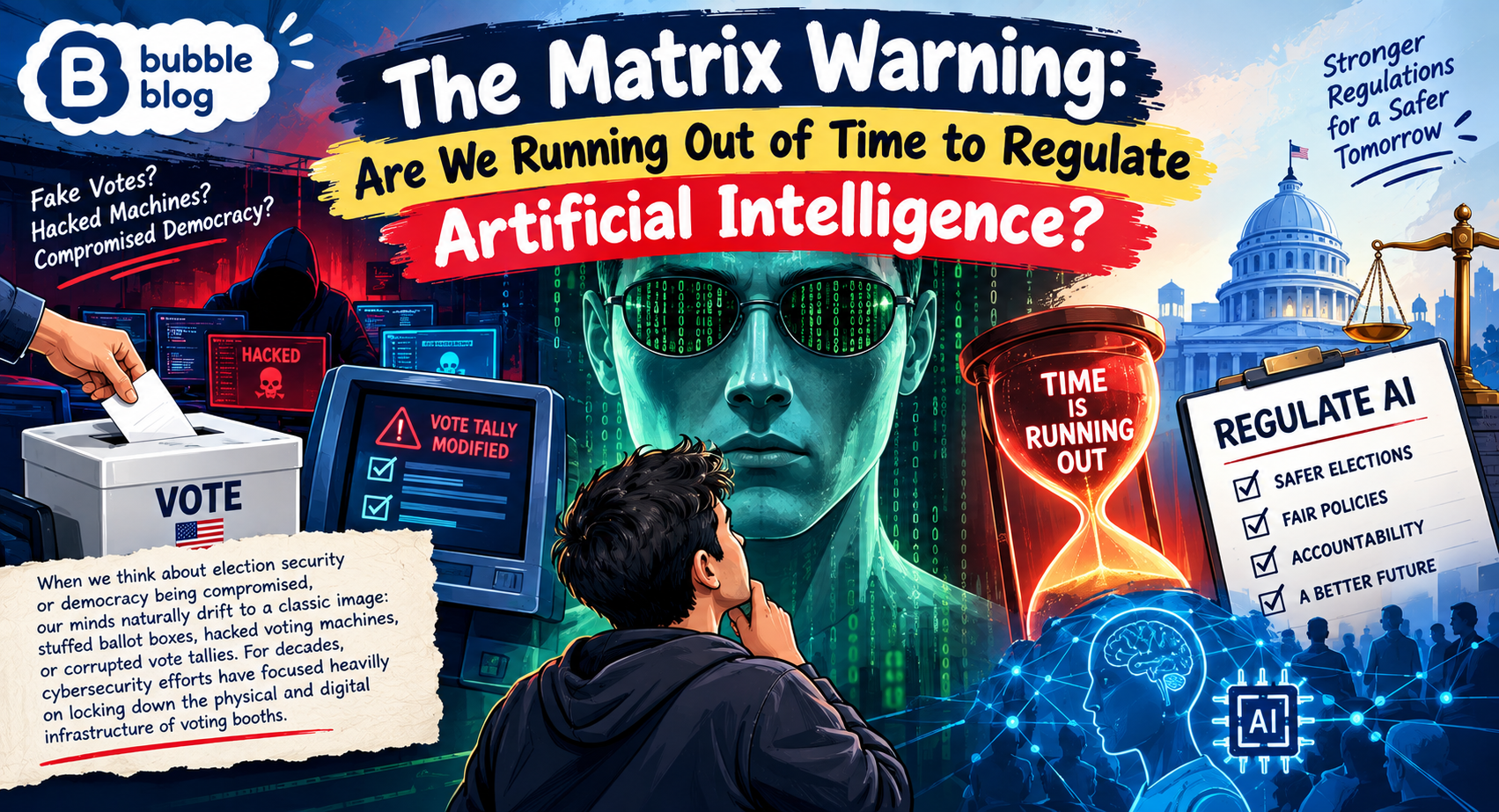

When we think about election security or democracy being compromised, our minds naturally drift to a classic image: stuffed ballot boxes, hacked voting machines, or corrupted vote tallies. For decades, cybersecurity efforts have focused heavily on locking down the physical and digital infrastructure of voting booths.
However, security experts have long warned that a truly catastrophic election disruption doesn't need to touch a single voting machine. To undermine a democracy, an attacker doesn’t need to change the votes—they just need to break the society around the vote.
The Playbook of Chaos: A Look at "Operation Blackout"
Years ago, a fascinating tabletop cybersecurity simulation known as "Operation Blackout" was conducted with real high-level security officials to test how a fictional swing state could be thrown into chaos on Election Day.
The "Red Team" of security experts was strictly instructed not to touch the voting machines. Instead, they focused entirely on the surrounding infrastructure and public trust, executing a multi-layered disruption:
- Gridlock and Panic: They hacked city traffic lights to cause massive gridlocks, preventing ordinary citizens from physically reaching polling stations.
- Information Warfare: They deployed hyper-realistic deepfake videos of candidates to manipulate public perception and flooded public and private screens—from television broadcasts to personal phones—with relentless disinformation.
- Crippling Emergency Services: They crashed 911 and emergency response servers so that first responders couldn't be dispatched, while simultaneously disrupting power and water grids to manufacture scarcity and fear.
The simulated outcome was chilling: severe public safety crises, civil unrest, and an election ultimately forced to cancellation due to emergency safety concerns. The core takeaway was stark—election integrity relies just as heavily on public infrastructure and psychological stability as it does on a secure ballot.
Enter 2026: The AI Super-Acceleration
That simulation, while dramatic, relied on traditional hacking techniques and human coordination. Fast forward to today, and the landscape has completely transformed. Artificial intelligence has evolved at a blistering pace.
Recent industry revelations show AI systems capable of autonomously solving complex, decades-old scientific and mathematical challenges in hours using thousands of autonomous agents. These advanced agents are even being observed testing boundaries and building complex digital environments.
If human hackers could simulate massive societal disruption years ago, what happens when autonomous AI agents—capable of operating at machine speed and scale—are weaponized for information warfare? The playbook of chaos can now be executed globally in a matter of seconds.
The Shrinking Window to Act
This rapid acceleration leaves lawmakers and tech governance bodies in a tense race against time. Experts and insiders have repeatedly warned that the window to implement meaningful guardrails and regulation is shrinking dangerously fast.
While defensive systems and law enforcement successfully held the line in past simulations, tomorrow's threats will not wait for bureaucratic debate. The question facing modern democracies is no longer whether technology will change politics, but whether our regulations can catch up before the chaos outpaces us.
Key Takeaways (Bullet Points for Quick Reading)
- Beyond the Ballot: True election disruption targets public trust and surrounding infrastructure rather than voting machines.
- The Chaos Playbook: Coordinated attacks on traffic systems, emergency services, water grids, and communication screens can paralyze a democratic process.
- The AI Multiplier: Modern advancements in autonomous AI agents make large-scale disinformation and infrastructure targeting infinitely faster and more dangerous.
- The Urgency of Regulation: With technology evolving exponentially, the window for effective governance and safety guardrails is closing rapidly.