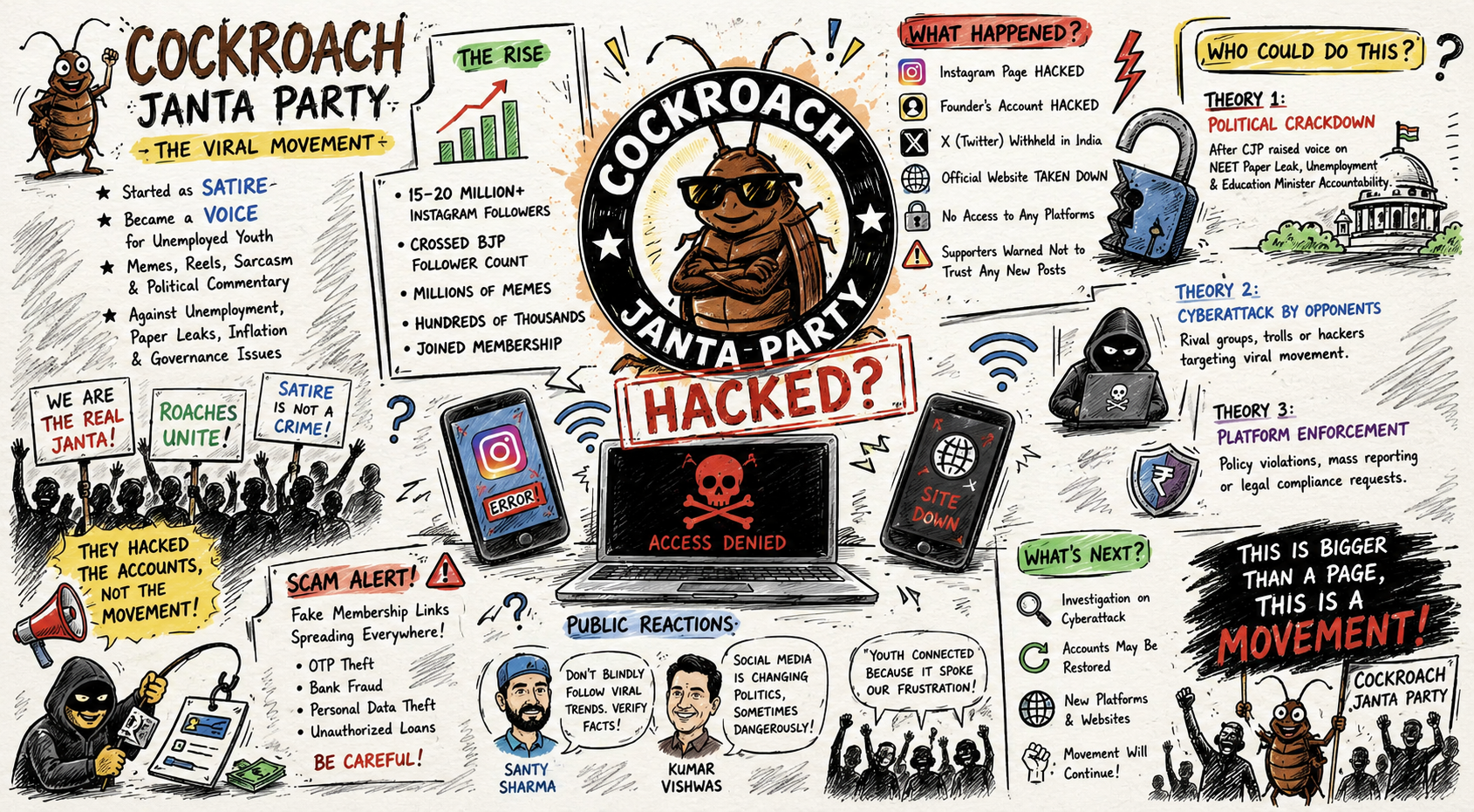

The internet sensation known as the “Cockroach Janta Party” (CJP) has suddenly become the center of a massive controversy after claims surfaced that its Instagram pages, X (Twitter) accounts, and official website were hacked or taken down. What started as a satirical online movement has now turned into one of the most discussed digital-political stories in India.
What Is the Cockroach Janta Party?
The Cockroach Janta Party was launched by Abhijeet Dipke, a Boston-based Indian student and former AAP associate. The movement exploded online within days, gaining millions of followers through memes, satire, youth-focused political commentary, and criticism of unemployment, exam paper leaks, inflation, and governance issues..
The name “Cockroach Janta Party” itself came after controversy around remarks allegedly comparing unemployed youth to “cockroaches.” The movement adopted the insult sarcastically and converted it into a symbol of protest and online rebellion.
Within less than a week:
- The page reportedly crossed 15–20 million Instagram followers.
- Hundreds of thousands joined membership campaigns.
- Memes flooded Instagram, X, and YouTube.
- Young users treated it as a voice against frustration and unemployment.
What Happened? Was CJP Really Hacked?
According to founder Abhijeet Dipke, several major incidents happened almost simultaneously:
Reported Incidents
- Main Instagram page allegedly hacked
- Founder’s personal Instagram allegedly hacked
- X (Twitter) account withheld in India
- Backup accounts removed
- Official website reportedly taken down
- Loss of access to official platforms
Dipke publicly posted:
“We currently do not have access to any of our platforms.”
He warned supporters not to trust any new posts appearing on the hacked accounts.
Why Did This Suddenly Happen?
This is where the controversy becomes political.
Theory 1: Coordinated Political Crackdown
Dipke and supporters claim this was not random hacking but a coordinated crackdown after CJP launched campaigns against:
- alleged NEET paper leak failures,
- unemployment,
- and Education Minister accountability.
Dipke accused authorities of targeting the movement instead of addressing student concerns. He described the situation as “digital censorship.”
Supporters online are calling it:
- suppression of satire,
- political intimidation,
- or silencing youth voices.
However, there is currently no official proof publicly released confirming government involvement in hacking the accounts.
Theory 2: Cyberattack by Opponents or Troll Groups
Another possibility is that:
- rival ideological groups,
- organized trolls,
- or hackers exploiting the viral popularity
may have targeted the accounts.
Viral political pages often become vulnerable because:
- admins use weak passwords,
- phishing attacks increase,
- fake login pages spread rapidly,
- or insiders leak credentials.
Cybersecurity experts say rapidly growing pages often fail to secure:
- 2-factor authentication,
- admin permissions,
- recovery emails,
- or API access.
At the moment, no forensic cybersecurity report has been published publicly proving exactly who hacked the systems.
Theory 3: Platform Enforcement, Not Hacking
Some analysts believe parts of the crackdown may actually be:
- platform moderation,
- policy violations,
- mass reporting campaigns,
- or legal compliance requests.
For example:
- X withholding accounts in India can happen due to legal requests or platform policies.
- Websites can also go offline because of domain suspension, hosting complaints, or traffic overload.
Again, there is no confirmed public evidence yet explaining the exact technical cause.
Fake Membership Links and Scam Warning
An even more dangerous twist emerged when police cyber cells issued warnings that scammers were using fake “Cockroach Janta Party membership” links to steal:
- OTPs,
- banking data,
- personal information,
- and money from users.
Authorities warned users not to:
- click unknown WhatsApp links,
- download suspicious apps,
- or enter bank details for “membership registration.”
Some victims reportedly faced unauthorized bank withdrawals and fraudulent loan activity.
This means the viral popularity of CJP may also have attracted cybercriminals trying to exploit the trend.
The Instagram Explosion That Shocked Indian Politics
One reason the story became so massive is because the movement reportedly crossed the follower count of the ruling BJP on Instagram within days.
That made national headlines and transformed the movement from “internet meme” into a serious political conversation.
The movement especially connected with:
- Gen Z,
- unemployed youth,
- students,
- meme culture creators,
- and anti-establishment internet users.
Reactions From Public Figures
Several public personalities reacted to the controversy.
Rapper Santy Sharma
Santy Sharma criticized blind support for viral internet movements and warned people to verify facts before joining online campaigns.
Kumar Vishwas
Kumar Vishwas mocked the rise of such internet-driven political trends while commenting on the influence of social media in modern politics.
The Bigger Issue: Why Youth Connected With It
The CJP phenomenon reflects something much larger than memes.
Reuters reported that many young Indians resonated with:
- unemployment fears,
- rising living costs,
- exam scandals,
- delayed careers,
- and frustration with traditional politics.
The movement used humor, sarcasm, and meme culture to express:
- anger,
- helplessness,
- and political dissatisfaction.
That is why even after accounts were allegedly hacked, supporters started reposting slogans like:
“They hacked the accounts, not the movement.”
Is There Proof of Hacking?
As of now:
- no independent cybersecurity audit has been released publicly,
- no official agency has confirmed a state-sponsored cyberattack,
- and no verified forensic evidence has identified the attackers.
Most reports currently rely on:
- statements by Abhijeet Dipke,
- screenshots shared online,
- platform takedowns,
- and media reporting.
So while the disruption appears real, the exact cause remains unclear.
What Happens Next?
Possible future developments:
- restoration of accounts,
- creation of new backup pages,
- cybercrime investigations,
- political debate over censorship,
- or further online mobilization.
Dipke has already hinted that the movement will return with new platforms and websites.
Final Thoughts
The Cockroach Janta Party story is no longer just a meme trend. It has become a case study in:
- viral internet politics,
- youth frustration,
- digital censorship debates,
- cybersecurity risks,
- and the power of social media movements.
Whether this was:
- genuine hacking,
- coordinated suppression,
- platform moderation,
- or opportunistic cybercrime,
one thing is clear: the movement exposed how quickly internet culture can transform into a national political conversation in modern India.