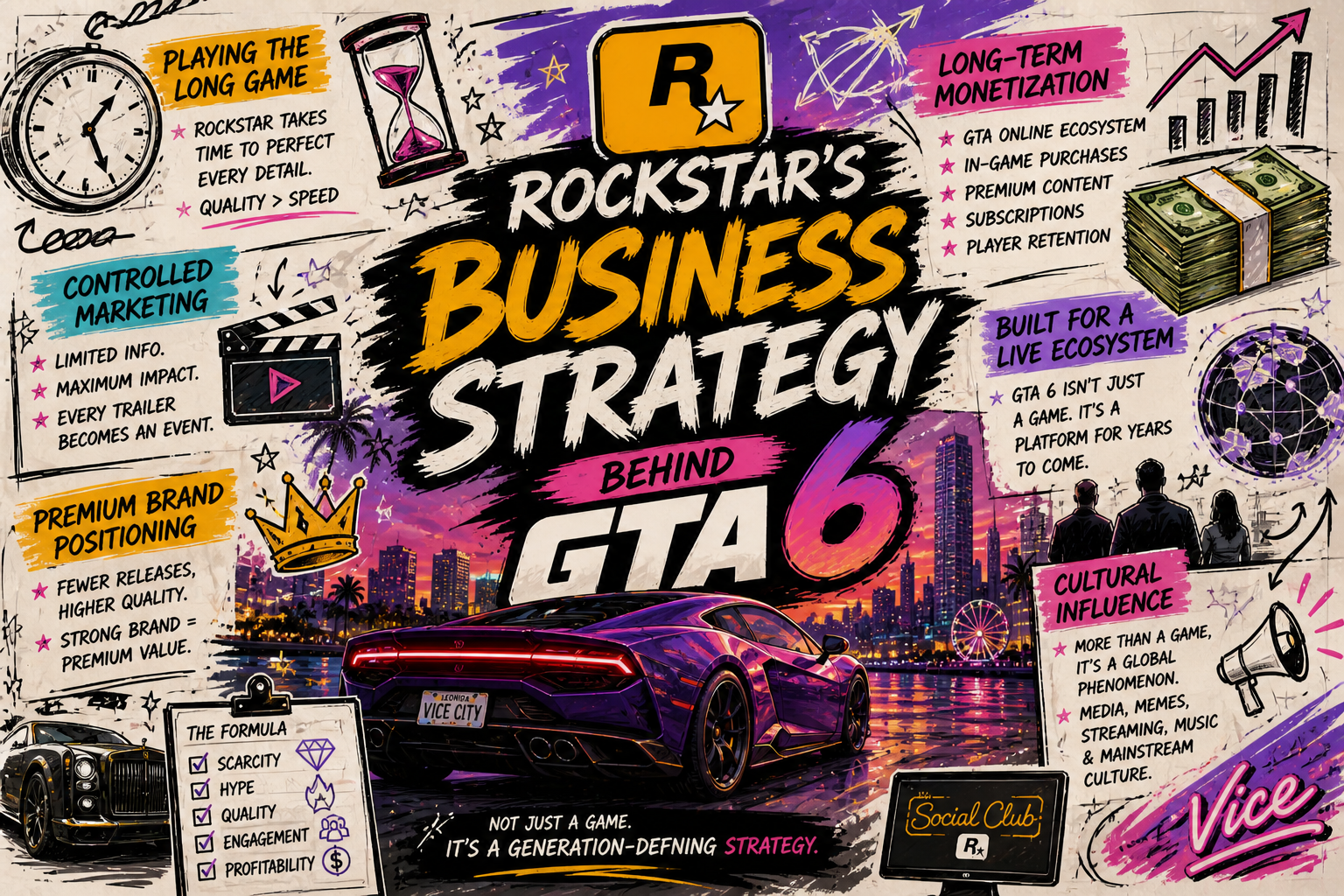

The launch of Grand Theft Auto VI is not just a gaming event-it is one of the most significant commercial strategies in entertainment today.
Behind the trailers, hype, and speculation lies a carefully structured business model designed to maximize long-term revenue, maintain brand prestige, and reshape industry expectations.
Rockstar is not simply releasing a game. It is executing a multi-layered strategy years in the making.
Why Rockstar Is Taking So Long
One of the biggest discussions around GTA 6 is its lengthy development cycle.
From a business perspective, that delay is strategic.
Rockstar understands that anticipation increases perceived value. By spacing out major releases, the company protects the exclusivity of its flagship franchises.
A rushed release could damage trust and reduce long-term profitability.
Instead, Rockstar positions GTA 6 as a premium event product—something players are willing to wait for because expectations remain exceptionally high.
That scarcity-driven approach strengthens demand.
The Power of Controlled Marketing
Rockstar’s marketing model is built on precision.
Unlike many publishers that reveal games years in advance through constant updates, Rockstar shares limited information at carefully chosen moments.
This creates intense online discussion and media amplification without overspending on traditional advertising.
Every trailer, teaser, or announcement becomes a global event.
The first GTA 6 trailer alone generated record-breaking engagement, proving that controlled scarcity can outperform continuous promotion.
In business terms, Rockstar leverages organic attention instead of relying solely on paid campaigns.
Long-Term Monetization Beyond Sales
The initial sale of GTA 6 is only one part of the revenue strategy.
A major financial driver will likely be the game’s online ecosystem.
Following the massive success of GTA Online, Rockstar is expected to build a multiplayer environment designed for recurring engagement.
This supports:
- in-game purchases
- premium content expansions
- subscription integrations
- long-term player retention
Rather than treating GTA 6 as a one-time transaction, Rockstar is building an ongoing digital platform.
That transforms the product into a service-based revenue engine.
Premium Branding Over Annual Releases
Unlike franchises that release yearly installments, Rockstar prioritizes fewer but larger launches.
This preserves quality perception and protects pricing power.
Consumers associate Rockstar titles with scale, detail, and longevity.
That brand positioning allows the company to charge premium prices while maintaining strong demand.
In contrast, frequent releases can dilute value.
Rockstar’s model depends on trust: players believe each release justifies the wait.
That trust becomes a competitive advantage.
Expanding Cultural Influence
GTA is no longer just a game series—it is a cultural property.
Rockstar benefits from crossover relevance in social media, streaming, memes, and mainstream news.
This creates an ecosystem where visibility extends far beyond traditional gaming audiences.
That broader relevance increases lifetime brand equity.
In practical terms, Rockstar is selling not only gameplay, but participation in a global cultural moment.
Final Thoughts
Rockstar’s business strategy behind GTA 6 is built on scarcity, prestige, ecosystem monetization, and long-term engagement.
The company has mastered the art of turning a product launch into a global event while building recurring revenue beyond initial sales.
GTA 6 represents more than technological ambition—it reflects one of the most sophisticated commercial strategies in modern entertainment.
And if history repeats itself, that strategy will not just make headlines—it will redefine profitability standards across the gaming industry.