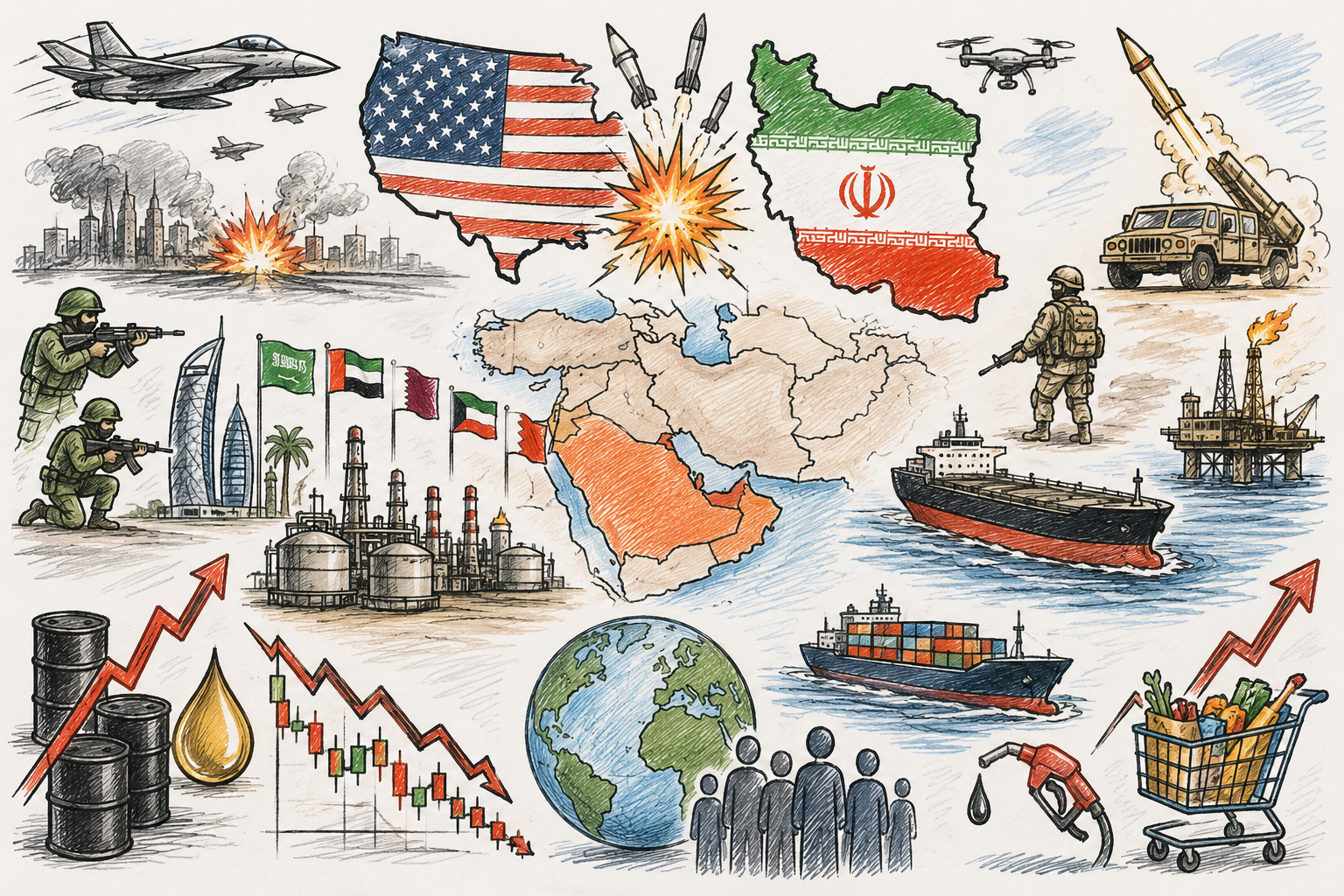

The Middle East is once again facing a major geopolitical crisis after military exchanges between the United States and Iran escalated in June 2026. Reports indicate U.S. strikes on Iranian military sites were followed by Iranian attacks targeting U.S.-linked facilities in countries such as Jordan, Kuwait, and Bahrain. The conflict has raised fears that the war could spread across the Gulf region and disrupt one of the world's most important energy corridors, the Strait of Hormuz.
The Strait of Hormuz is a narrow sea route through which roughly one-fifth of the world's oil trade passes. Any disruption there immediately affects oil prices, shipping costs, stock markets, and inflation worldwide.
Why Is the Strait of Hormuz So Important?
Strait of Hormuz is often called the world's most important oil chokepoint.
Every day, millions of barrels of oil and liquefied natural gas (LNG) pass through this route from Gulf countries to Asia, Europe, and North America. If ships cannot move freely through the strait:
- Oil supply decreases
- Fuel prices rise
- Shipping costs increase
- Inflation rises globally
- Stock markets become volatile
Experts estimate that around 20% of global oil and LNG trade depends on this corridor.
Countries Suffering the Most
🇮🇷 Iran
Iran is directly involved in the conflict and faces:
- Military losses
- Infrastructure damage
- Economic sanctions
- Reduced foreign investment
- Currency pressure
Long-term confrontation has already caused major economic losses and reduced international trade opportunities.
🇺🇸 United States
The U.S. faces:
- Increased military spending
- Risk to troops stationed across the Middle East
- Higher gasoline and energy prices
- Political pressure from rising inflation
American military bases in the Gulf region remain potential targets during escalation.
🇮🇱 Israel
Israel faces:
- Missile threats
- Regional security challenges
- Increased defense spending
- Potential attacks from Iran-backed groups
Markets remain concerned that broader regional conflict could pull Israel into a larger war.
🇰🇼 Kuwait, 🇧🇭 Bahrain & 🇯🇴 Jordan
These countries are suffering because:
- Missile threats have been reported near strategic locations.
- Air-defense systems have been activated.
- Investor confidence has weakened.
- Tourism and aviation industries face uncertainty.
These nations host strategic military facilities and lie close to the conflict zone.
🇶🇦 Qatar
Qatar is among the world's largest LNG exporters.
Any disruption to Gulf shipping routes can affect:
- Natural gas exports
- Global LNG prices
- European energy security
Qatar's economy is heavily connected to uninterrupted maritime trade.
🇸🇦 Saudi Arabia & 🇦🇪 United Arab Emirates
These Gulf economies are affected through:
- Reduced investor confidence
- Oil infrastructure risks
- Higher insurance costs for shipping
- Market declines
Regional stock markets have already shown weakness following renewed hostilities.
Impact on India 🇮🇳
India is one of the countries most exposed to the crisis.
1. Higher Petrol & Diesel Prices
India imports most of its crude oil.
When oil rises from $80–90 to $100+ per barrel:
- Petrol becomes expensive
- Diesel costs rise
- Transportation costs increase
2. Inflation
Higher fuel costs affect:
- Food prices
- Logistics
- Manufacturing
- Air travel
Everything from vegetables to online deliveries can become more expensive.
3. LPG Supply Risk
India receives significant LPG supplies from Gulf nations.
Any disruption in Gulf shipping can affect cylinder availability and prices.
4. Stock Market Volatility
Sectors that may suffer:
- Airlines
- Paint companies
- Logistics
- Chemical manufacturers
Sectors that may benefit:
- Oil producers
- Defense companies
- Energy firms
Impact on Global Economy
Oil Prices Rising
Oil recently climbed near $92 per barrel as markets reacted to the escalation. Investors fear further supply disruptions.
Stock Markets Falling
Asian and Gulf markets have seen declines as investors move toward safer assets.
Higher Inflation
Rising energy costs increase prices across:
- Manufacturing
- Transportation
- Agriculture
- Consumer goods
This can force central banks to keep interest rates high.
Who Benefits From the Crisis?
While wars hurt most economies, some sectors can benefit temporarily:
Defense Companies
Governments often increase military spending.
Oil Producers
Higher crude prices can increase profits.
Gold
Investors frequently buy gold during geopolitical uncertainty.
Energy Exporters
Countries outside the conflict zone may gain from higher commodity prices.
What Happens Next?
Best-Case Scenario
- Diplomatic negotiations succeed.
- Shipping routes remain open.
- Oil prices stabilize.
- Global markets recover.
Moderate Scenario
- Limited military exchanges continue.
- Energy prices stay elevated.
- Inflation remains a concern.
Worst-Case Scenario
- Strait of Hormuz faces major disruption.
- Oil exceeds $100–120 per barrel.
- Global recession risks increase.
- International trade slows significantly.
Conclusion
The 2026 Middle East crisis is no longer just a regional conflict. It has become a global economic issue affecting energy prices, inflation, stock markets, airlines, trade routes, and consumers worldwide. Countries most exposed include Iran, the United States, Israel, Saudi Arabia, UAE, Qatar, Kuwait, Bahrain, Jordan, and major oil-importing nations such as India. The next few weeks will be critical in determining whether the world moves toward diplomacy or a deeper geopolitical and economic crisis.