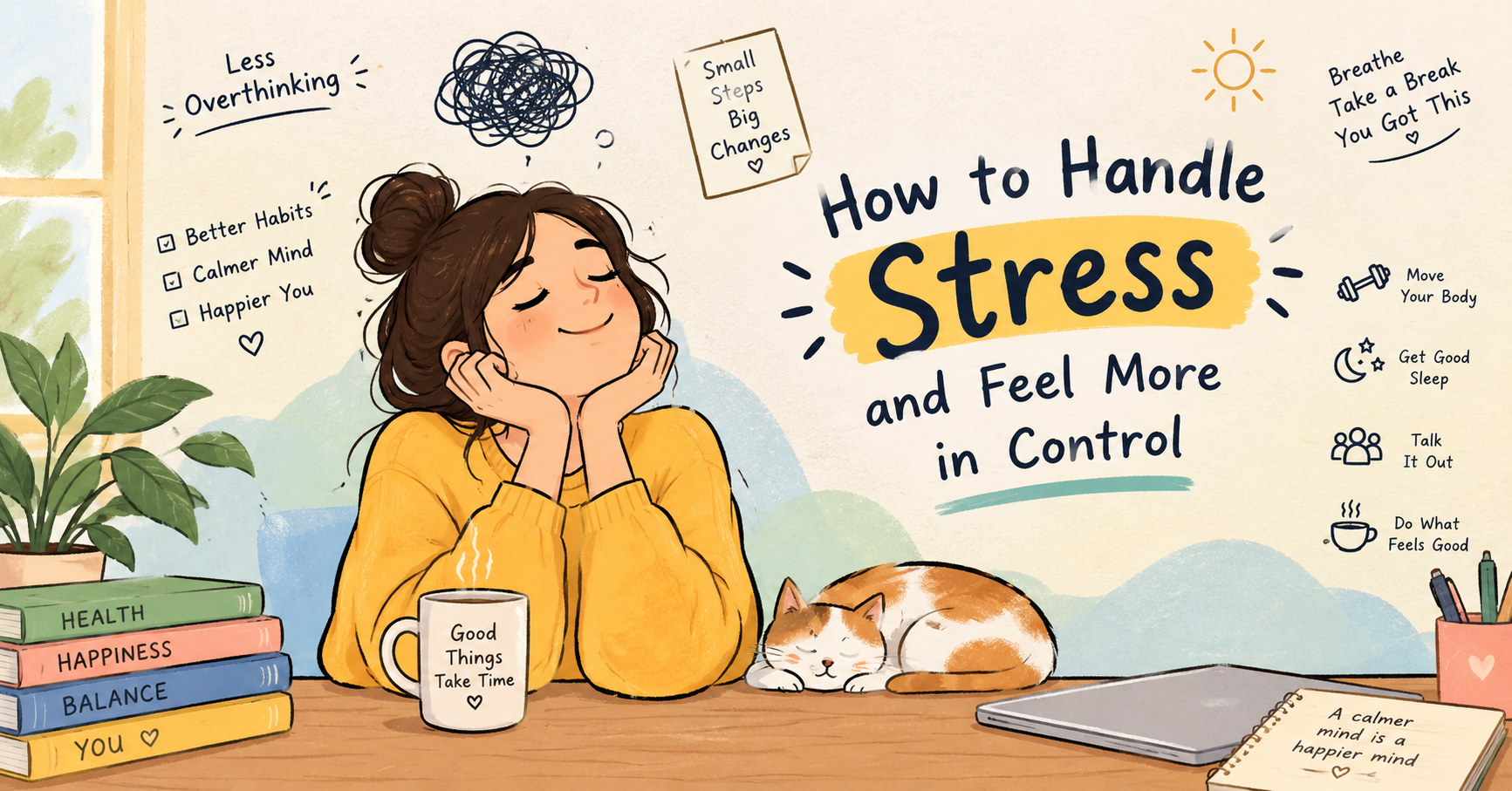

Stress has a strange way of making everything feel urgent.
One minute you are checking your phone, answering messages, finishing work, or thinking about tomorrow. The next, your mind is running through ten different problems at once. You may feel tired but still unable to relax, irritated over small things, or simply feel like you need a break but cannot actually switch off.
A little stress is a normal part of life. Deadlines, exams, money worries, relationships, work pressure, and major life changes can all trigger it. The problem starts when stress becomes your everyday background noise.
The good news is that handling stress does not always require a dramatic lifestyle change. Small habits, repeated consistently, can make a real difference.
First, Understand What Stress Is Doing to You
Stress is your body's response to pressure or a perceived threat. It can temporarily make you more alert and focused, which is useful when you need to deal with a difficult situation.
But when that pressure continues for too long, it can start affecting both your mind and body.
You might notice:
- Constant worrying
- Difficulty concentrating
- Headaches or muscle tension
- Feeling unusually irritated
- Changes in sleep
- Feeling tired even after resting
- Eating much more or less than usual
- Losing interest in things you normally enjoy
- Feeling overwhelmed by small tasks
Sometimes the biggest sign is simply feeling like you are always switched on.
Recognising these signs is important because you cannot manage stress effectively if you keep treating it as something you just have to tolerate.
Stop Trying to Solve Everything at Once
When you are stressed, your brain tends to turn one problem into twenty.
A work deadline becomes, "What if I cannot finish it?"
That becomes, "What will my manager think?"
Then comes, "What if I lose this opportunity?"
Suddenly, you are worrying about a future that has not even happened.
Instead of trying to solve everything simultaneously, ask yourself:
What is the one thing I can actually deal with right now?
Write down everything that is bothering you and separate it into three categories:
SituationWhat to doSomething I can controlTake one practical stepSomething I can influenceFocus on what is within my reachSomething I cannot controlStop spending energy trying to predict it
This simple distinction can make a stressful situation feel much more manageable.
Give Your Mind a Proper Break
Scrolling through social media while thinking about work is not really a mental break.
Your brain needs periods where it does not have to process constant information.
Try taking 10 to 15 minutes without your phone. Sit outside, take a slow walk, listen to music, make tea, stretch, or simply sit quietly.
It may feel unproductive at first.
It isn't.
A short pause can give your mind some breathing room before you return to whatever needs your attention.
Try the 5-Minute Breathing Reset
When stress suddenly rises, slow breathing can help you shift away from that tense, rushed feeling.
Try this:
Inhale slowly for 4 seconds.
Exhale slowly for 6 seconds.
Continue for about five minutes.
The longer exhale encourages slower breathing and can help you feel calmer. You do not need a special app or complicated meditation technique. You can do it at your desk, before an important meeting, or when you are lying in bed.
Move Your Body
You do not have to become a fitness enthusiast to use movement as a stress-management tool.
A 20-minute walk can be enough to get you away from your immediate environment and give your mind a change of scenery.
You could also try:
- Stretching
- Cycling
- Dancing
- Yoga
- Jogging
- Strength training
- Playing a sport
The goal is not to burn as many calories as possible.
The goal is to move instead of staying stuck in the same stressful mental loop.
Protect Your Sleep
Stress and poor sleep can easily turn into a vicious cycle.
You are stressed, so you sleep badly. You wake up exhausted, so everything feels harder. Because everything feels harder, you become more stressed.
Try keeping your sleep schedule reasonably consistent and give yourself some quiet time before bed.
You can also:
- Keep your bedroom dark and comfortable
- Avoid heavy meals immediately before sleeping
- Reduce caffeine later in the day
- Put your phone away for some time before bed
- Avoid taking work into bed
You do not need a perfect nighttime routine. Even a calmer final 30 minutes can help.
Be Careful With Caffeine
Coffee can be great when you need a morning boost, but using caffeine to survive constant tiredness can sometimes make stress feel worse.
Too much caffeine may contribute to restlessness, a racing heartbeat, or difficulty sleeping in some people.
If you are already feeling anxious or overstimulated, consider reducing your intake and especially avoid having large amounts late in the day.
You do not necessarily have to give up coffee. Sometimes timing and quantity are enough to make a difference.
Talk Instead of Keeping Everything Inside
Stress becomes heavier when you carry it alone.
Talking to a friend, family member, partner, colleague, or someone you trust can help you look at a situation differently.
You do not always need advice.
Sometimes saying, "I am having a really difficult week" is enough to start feeling less alone.
If stress has become persistent or is interfering with your daily life, speaking with a mental health professional can also be a valuable step.
Stop Expecting Yourself to Be Productive All the Time
One of the most underrated causes of stress is the feeling that you should always be doing something.
Work.
Study.
Exercise.
Reply to messages.
Learn something new.
Build your career.
Improve yourself.
The list never ends.
Rest is not something you have to earn after becoming completely exhausted.
It is part of maintaining yourself.
Give yourself permission to have an ordinary evening where you do not accomplish anything impressive.
Watch a movie. Cook something. Read a book. Meet a friend. Listen to music.
Your entire life does not have to be optimized.
Try a Simple "Stress List"
When your thoughts are racing, take a piece of paper and write down everything currently occupying your mind.
Do not organise it initially. Just write.
Then look at the list and mark each item:
Today: Something I need to handle soon.
Later: Important, but it can wait.
Not mine: Something I cannot control or something that does not actually require my attention.
This can prevent your brain from repeatedly reminding you about the same things.
Take Small Breaks Before You Need Them
Many people wait until they are completely exhausted before taking a break.
Try doing the opposite.
If you are working for several hours, take short breaks before your concentration completely disappears. Stand up, stretch, drink water, look away from the screen, or walk around for a few minutes.
Small breaks are easier to take than recovering from complete burnout.
Learn to Say No
Sometimes stress is not caused by one huge problem.
It is caused by too many small commitments.
You agree to one more task.
One more favour.
One more meeting.
One more plan.
Eventually, your calendar is full and your mind has no space left.
You do not have to say yes to everything.
A simple "I won't be able to take this on right now" can protect your time and energy.
Make Your Day Slightly Easier
When life feels overwhelming, do not try to completely reinvent your routine.
Make tomorrow 10% easier.
Prepare your clothes tonight.
Write down tomorrow's priorities.
Clean your workspace.
Prepare breakfast.
Finish one small task that has been sitting on your mind.
These little actions remove friction from the next day and can give you a sense of control.
What If You Cannot Relax Even When You Have Time?
This is surprisingly common.
You finally have free time, but instead of relaxing, you start thinking about everything that needs to be done.
If that happens, do not force yourself to "stop thinking."
Give your mind something gentle to focus on.
Take a slow walk without constantly checking your phone. Read a few pages of a book. Take a shower. Cook something. Do some light stretching.
Relaxation is a skill, and sometimes your brain needs time to relearn it.
When Stress Needs More Than Self-Care
Everyday stress is normal, but you should not feel that you have to handle severe or persistent stress completely on your own.
Consider talking to a qualified mental health professional if stress is lasting for a long time, interfering with your work or relationships, regularly disturbing your sleep, or becoming difficult to manage.
And if you ever feel unsafe or think you may hurt yourself, seek immediate help from emergency services or a crisis service in your area and reach out to someone you trust.
The Bottom Line
You do not have to eliminate every stressful situation from your life.
That is impossible.
The real goal is to become better at recognising stress before it completely takes over and having a few reliable ways to bring yourself back to a calmer state.
Start small.
Take the walk.
Put the phone away.
Take five slow breaths.
Write down what is bothering you.
Talk to someone.
Go to bed on time.
Say no when your plate is already full.
Stress may always be a part of life, but it does not have to run your life.