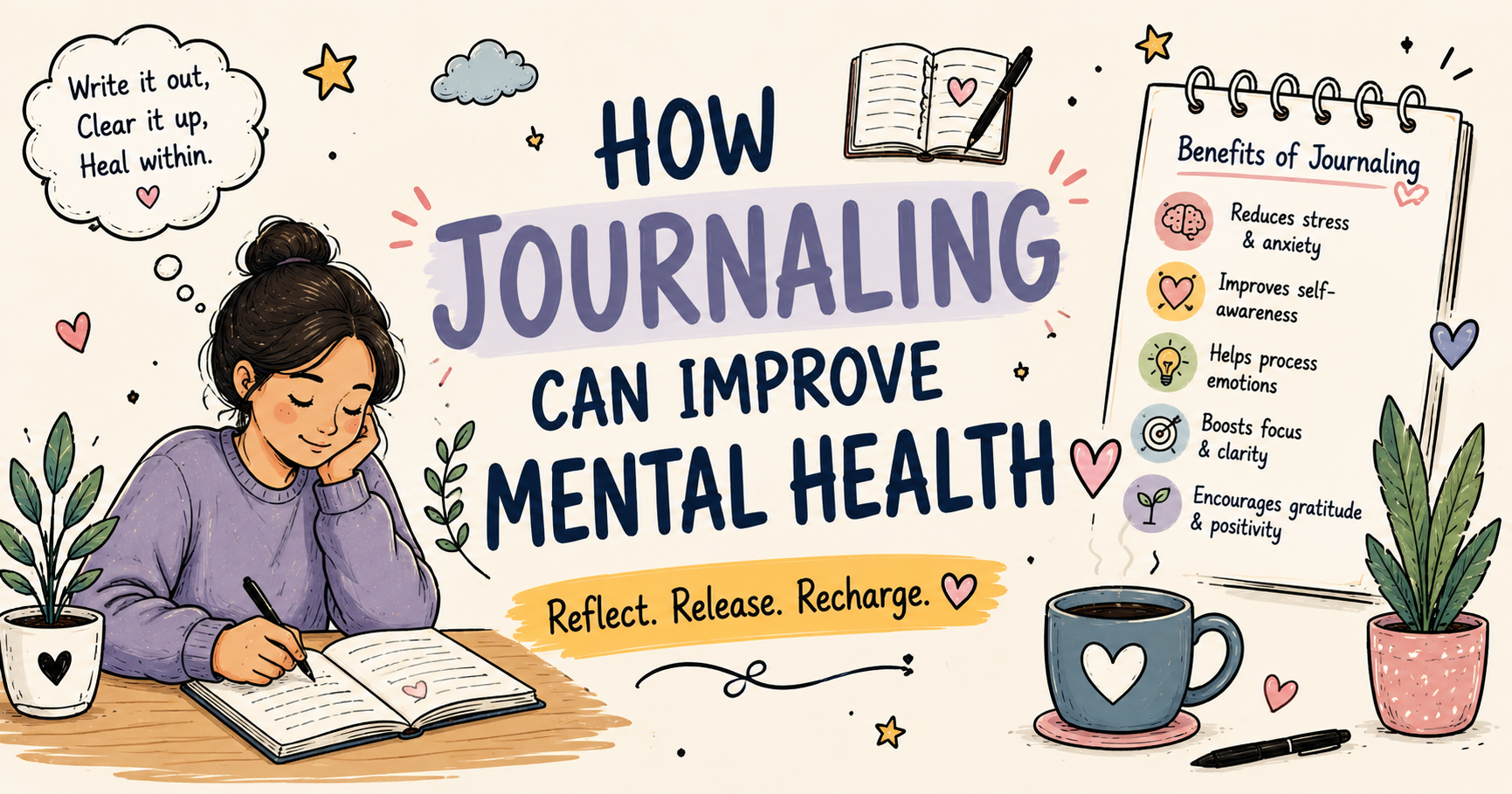

Your mind can feel crowded even when your day looks completely normal.
You may be thinking about an argument from yesterday, worrying about tomorrow's responsibilities, replaying something embarrassing you said, or simply carrying around a long list of things you haven't had time to process.
Sometimes, putting those thoughts into words can make them feel a little more manageable.
That's where journaling comes in.
Journaling isn't about writing a perfect diary entry or documenting everything that happens during your day. It can be as simple as spending five minutes writing down what you're feeling, what is worrying you, or what you want to accomplish.
Research on journaling and expressive writing suggests that writing-based interventions can have small to moderate mental-health benefits for some people, although the evidence is mixed and the effects vary depending on the type of writing and the person. A systematic review of randomized trials found potential benefits for people experiencing depression, anxiety, PTSD, and related conditions, while also noting substantial differences between studies.
So, what makes journaling useful?
And how can you actually start without turning it into another task on your to-do list?
Let's explore it.
What Is Journaling?
Journaling is the practice of regularly writing down your thoughts, feelings, experiences, observations, or goals.
There isn't one correct way to journal.
You could write:
- What happened during your day
- How you're feeling
- Something you're worried about
- Things you're grateful for
- A problem you're trying to solve
- Goals you want to achieve
- Questions you want to think about
- Things you learned
- Thoughts you don't feel comfortable saying out loud
You don't need an expensive notebook, beautiful handwriting, or a perfectly organized routine.
A notebook, notes app, or simple document can work.
The important part is creating a space where you can put your thoughts into words.
How Can Journaling Help Your Mental Health?
1. It Can Help You Organize Racing Thoughts
One of the biggest benefits of journaling is surprisingly simple:
It gets thoughts out of your head and onto paper.
When several worries are competing for your attention, they can feel much larger and more confusing than they actually are.
Writing them down can help you separate them.
For example, instead of thinking:
"Everything is going wrong and I don't know what I'm doing."
You might write:
- I'm worried about my career.
- I have an important decision to make.
- I'm comparing myself with other people.
- I don't know what my next step should be.
The problem hasn't magically disappeared.
But you've turned a vague feeling into several specific issues that you can think about individually.
Research into expressive writing has proposed that putting stressful experiences into a more organized narrative may reduce intrusive thoughts and help people process difficult experiences.
2. Journaling Can Help You Understand Your Emotions
Sometimes you know that you're upset without knowing why.
You might think you're angry when you're actually disappointed.
You might think you're lazy when you're actually overwhelmed.
You might think you're unmotivated when you're simply exhausted.
Writing can give you the time and space to explore those distinctions.
Try asking:
What am I feeling right now?
Then ask:
What happened that made me feel this way?
And finally:
What do I need right now?
You don't have to find a perfect answer.
Even identifying the emotion can be useful.
3. It Can Help Reduce Mental Clutter
Your brain has a limited amount of attention available.
When you're constantly remembering tasks, appointments, worries, conversations, and unfinished plans, your attention can feel scattered.
A journal can become an external place to store some of those thoughts.
For example:
Things on my mind tonight
- Reply to an important email
- Finish my assignment
- Call a family member
- Buy groceries
- Think about next week's presentation
Once they're written down, you don't have to keep reminding yourself about every single item.
This doesn't mean journaling automatically reduces stress for everyone, but it can provide a structured way to identify and organize what's occupying your attention.
4. Journaling May Help You Notice Negative Thought Patterns
We often repeat the same mental patterns without realizing it.
For example:
"I always mess things up."
"Everyone else is doing better than me."
"If I make one mistake, everything will go wrong."
When these thoughts stay inside your head, they can feel like facts.
Writing them down gives you an opportunity to examine them.
Try using this simple format:
Thought
"I'm not good enough to do this."
Evidence for it
"I made several mistakes last week."
Evidence against it
"I've successfully completed similar tasks before."
A more balanced thought
"I'm struggling with this right now, but that doesn't mean I'm incapable of improving."
This isn't about forcing yourself to be positive.
It's about becoming more aware of how you think.
5. Gratitude Journaling Can Encourage Positive Reflection
Journaling doesn't always have to focus on problems.
A simple gratitude practice can encourage you to pay attention to positive experiences that might otherwise get overlooked.
A 2025 systematic review of positive expressive-writing interventions found the most consistent benefits in areas such as well-being and positive affect, with gratitude and "best possible self" exercises among the approaches showing relatively consistent results. The researchers also cautioned that the overall quality of evidence varied.
You don't need to write a page.
Try writing three things:
- Something that made you smile today
- Someone you appreciated
- Something you are looking forward to
They can be extremely small.
A good cup of tea counts.
A funny conversation counts.
Finishing something you've been procrastinating on counts.
The goal isn't to pretend everything is wonderful.
It's to notice that difficult experiences aren't necessarily the only things happening in your life.
6. It Can Help You Process Difficult Experiences
Expressive writing is different from simply keeping a daily diary.
In expressive writing, people may write about emotionally significant or stressful experiences and explore their thoughts and feelings surrounding them.
Research has found potential benefits from structured expressive-writing interventions, although results aren't uniform across populations or conditions. A 2024 systematic review and meta-analysis found that several creative-writing studies reported improvements in depressive symptoms, while also noting that more research is needed.
If you try this approach, you don't have to force yourself to write about extremely painful experiences.
Start with something manageable.
For example:
"Something I've been thinking about lately is..."
Then write freely for several minutes.
You don't need to make the writing beautiful.
You don't even need to read it again.
7. Journaling Can Help You Track Your Mood
A journal can also become a record of how you feel over time.
Instead of simply thinking:
"I've been stressed forever."
You might begin noticing:
- Stress is worse after poor sleep.
- Certain situations trigger anxiety.
- I feel better after exercising.
- I become more irritable when I skip meals.
- Social media makes me compare myself with others.
- I feel calmer when I have a structured morning.
These observations don't diagnose anything.
But they can help you recognize patterns that you might otherwise overlook.
8. It Can Help With Problem-Solving
Sometimes worrying feels like problem-solving, but the two aren't necessarily the same.
Worry:"What if everything goes wrong?"
Problem-solving:"What can I actually do about this?"
Journaling can help you make that transition.
Try this:
The problem
What exactly is bothering me?
What I can control
What part of this situation is actually within my control?
What I can't control
What do I need to stop spending energy on?
My next step
What is one small thing I can do today?
That final question is important.
You don't always need a complete solution.
Sometimes you just need a next step.
9. Journaling Can Create a Pause Before You React
Imagine receiving a message that makes you angry.
Your first instinct might be to immediately respond.
Instead, open your journal.
Write:
"This message made me feel..."
Then explain why.
After five minutes, you may still feel angry.
But you may also have a clearer idea of what you actually want to say.
Journaling isn't a substitute for communication.
It simply gives you a moment to understand your reaction before acting on it.
10. It Can Help You Reflect on Personal Growth
One of the most underrated benefits of keeping a journal is being able to look backward.
A problem that feels enormous today might seem completely different six months later.
Old journal entries can show you:
- Problems you've already overcome
- Habits you've changed
- Goals you've achieved
- Patterns you've repeated
- Situations you've learned from
- Things that once worried you but no longer do
This can make progress easier to recognize.
Sometimes growth happens so gradually that you don't notice it until you look back.
5 Types of Journaling You Can Try
You don't have to use the same journaling style every day.
1. Brain-Dump Journaling
Write whatever is in your head without organizing it.
Example:
"I have so much to do tomorrow and I'm worried I'm going to forget something..."
Keep writing until you've emptied out the main thoughts occupying your attention.
Best for:
Mental clutter and busy days.
2. Gratitude Journaling
Write down three things you're grateful for.
Best for:
Positive reflection and noticing everyday experiences.
3. Mood Journaling
Record:
Mood: 6/10Energy: 5/10Main emotion: FrustratedPossible trigger: Difficult conversationWhat helped: Walking outside
Best for:
Recognizing patterns over time.
4. Problem-Solving Journaling
Write down a problem and divide it into:
- What happened?
- What can I control?
- What can I change?
- What is my next step?
Best for:
Decision-making and everyday stress.
5. Future-Self Journaling
Imagine yourself six months or one year from now.
Ask:
What would I like my life to look like?
What habits would future me have?
What would I wish I had started today?
Best for:
Goals, motivation, and personal reflection.
How to Start Journaling If You've Never Done It Before
You don't need to write for 30 minutes every morning.
Start ridiculously small.
Try the 5-Minute Journal Method
Set a timer for five minutes.
Then complete these prompts:
1. Right now I'm feeling...
2. The main thing on my mind is...
3. One thing I can control today is...
4. Something I'm grateful for is...
5. One small thing I want to accomplish is...
That's it.
If you want to continue, keep writing.
If you don't, close the notebook.
Five minutes is enough to establish the habit.
When Should You Journal?
There is no scientifically proven "perfect" journaling time.
Choose the time you're most likely to maintain.
Morning
Useful for:
- Planning your day
- Setting intentions
- Writing goals
- Clearing your mind
Evening
Useful for:
- Reflecting on your day
- Processing emotions
- Writing gratitude
- Preparing mentally for tomorrow
During stressful moments
Useful for:
- Identifying emotions
- Organizing thoughts
- Slowing down before reacting
The best journaling routine is usually the one you can actually stick with.
What If You Don't Know What to Write?
This is probably the biggest beginner problem.
Don't wait for inspiration.
Use prompts.
Try:
- What is taking up most of my mental space today?
- What am I avoiding?
- What am I worried about?
- What do I wish someone understood about me?
- What made me feel good today?
- What drained my energy?
- What is within my control right now?
- What do I need more of?
- What do I need less of?
- What would I tell a friend in my situation?
- What is one thing I can do tomorrow to make my day easier?
You don't have to answer all of them.
Pick one.
Should You Journal About Negative Experiences?
You can, but more isn't necessarily better.
If writing about a difficult experience makes you feel increasingly overwhelmed, distressed, or stuck in repetitive rumination, stop and switch to something grounding.
You could write about:
- What you're feeling right now
- What you can control
- Something safe and comforting
- A positive memory
- What you need today
- A practical next step
Journaling should be a tool that supports reflection, not a requirement to repeatedly relive painful experiences.
Journaling vs. Therapy: What's the Difference?
This distinction is important.
Journaling is a self-help practice.
Therapy involves working with a trained mental-health professional who can assess your concerns, provide evidence-based treatment, and help you work through issues in a structured way.
Journaling can complement therapy.
It can help you record thoughts between sessions, identify patterns, or prepare topics you'd like to discuss.
But journaling shouldn't be presented as a replacement for professional treatment.
A systematic review of journaling interventions found some evidence of benefit, but also substantial variation between studies and limitations in the research.
A Simple 7-Day Journaling Challenge
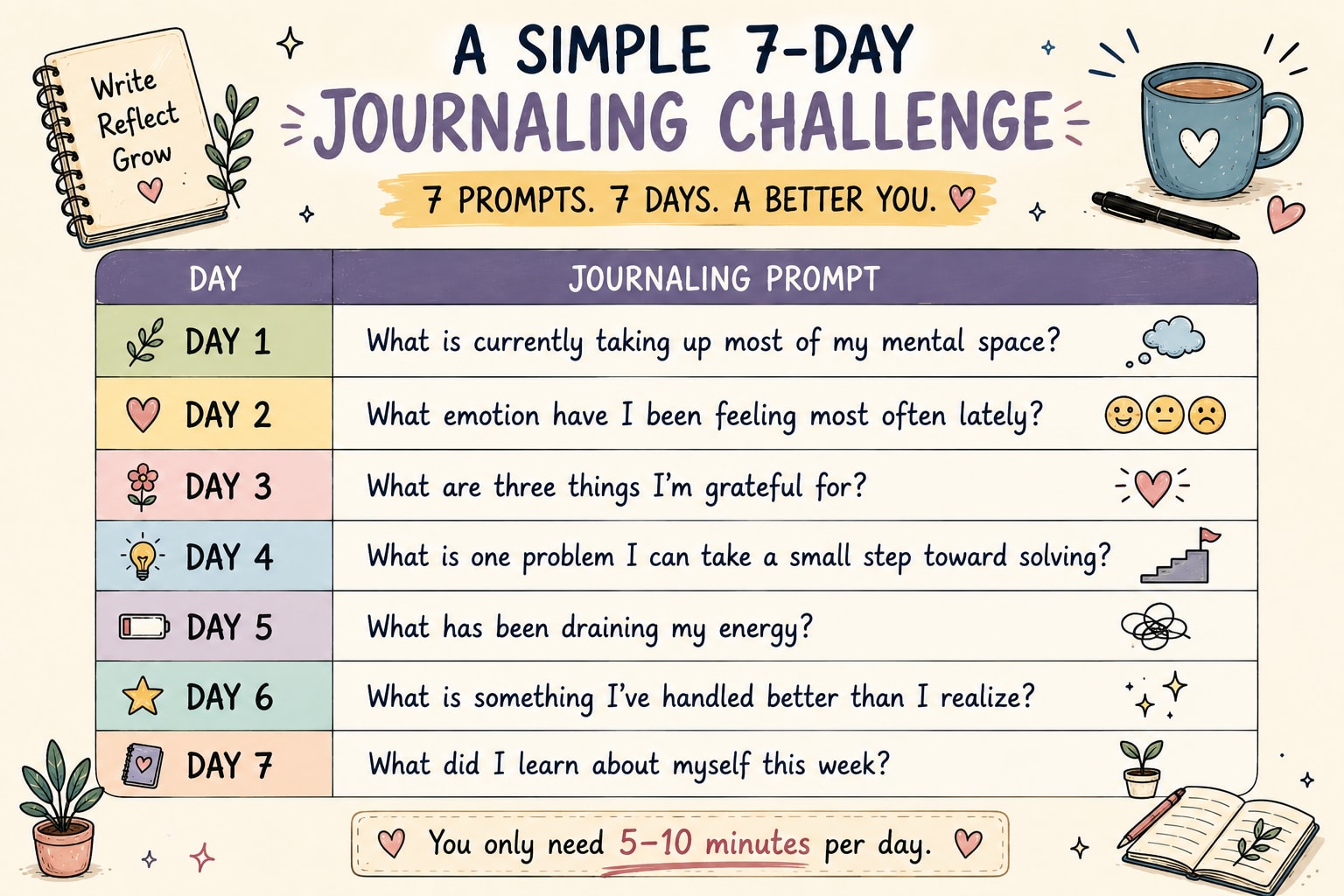
You only need 5–10 minutes per day.
Don't worry about grammar, handwriting, or making your entries sound intelligent.
This is your journal.
It's not an essay.
Common Journaling Mistakes to Avoid
Making it another productivity task
You don't need to journal every morning at 5 a.m. for it to count.
Trying to write perfectly
Your journal isn't being graded.
Forcing yourself to be positive
You don't have to turn every difficult experience into a lesson.
Overanalyzing everything
Reflection is useful.
Constantly dissecting every thought can become exhausting.
Comparing your journal with someone else's
There is no ideal journaling aesthetic.
Your messy notebook is just as useful as someone's perfectly organized bullet journal.
The Bottom Line
Journaling isn't a magical cure for stress, anxiety, depression, or other mental-health conditions.
But it can be a simple and inexpensive way to create space between what you're experiencing and how you respond to it.
Writing can help you organize thoughts, identify emotions, reflect on experiences, recognize patterns, practice gratitude, and turn vague worries into specific problems that may be easier to approach.
The research is promising but not definitive. Benefits vary depending on the type of writing, the person, and the circumstances.
So don't worry about finding the "perfect" journaling method.
Take a notebook.
Set a timer for five minutes.
And start with one honest sentence:
"Right now, I'm feeling..."
You can figure out the rest from there.
Disclaimer: This article is for general educational purposes and is not a substitute for professional mental-health advice, diagnosis, or treatment. If you're experiencing persistent or severe emotional distress, speak with a qualified mental-health professional.