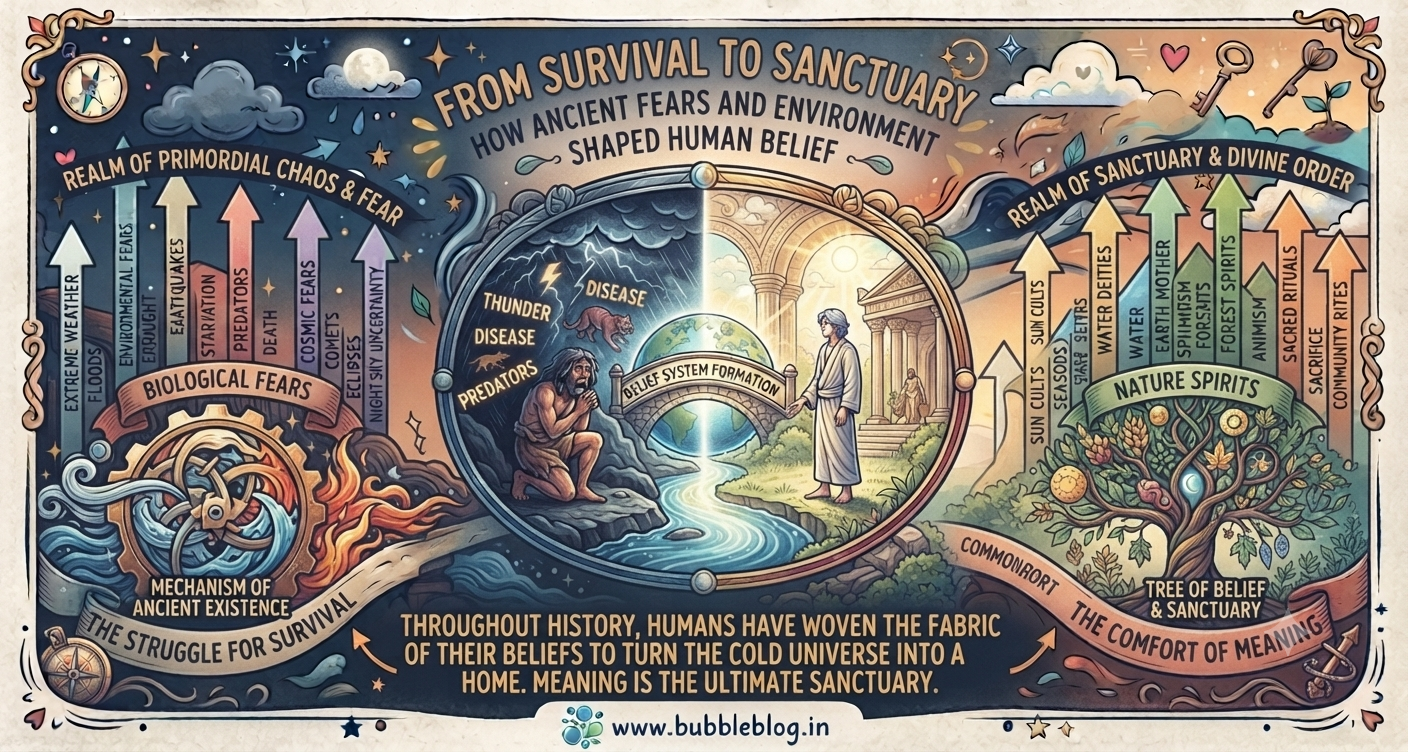

If you look across the vast tapestry of human history, one thing stands out above all else: humanity's deep-rooted connection to the divine. From towering temples and ancient rituals to quiet prayers whispered in the dark, religion and belief have shaped civilizations. But have you ever wondered where it all actually began?
If we strip away centuries of dogma and look at the blueprint of human history through the lens of survival and psychology, a fascinating story emerges. Long before complex theological debates, gods were born out of a very human necessity: the need to make sense of an unpredictable world.
The Environment as Our First Altar
Imagine looking at the world through the eyes of our ancient ancestors. You are at the mercy of elements you cannot control. The rain either feeds your crops or washes them away; the ocean either provides bountiful fish or swallows your boats whole; the mountain protects you or traps you.
Because survival depended entirely on the environment, human imagination naturally bridged the gap between the unknown and the sacred:
- The Coastal Tribes: Looked at the vast, unpredictable sea and worshipped deities of the ocean, respecting a force that was simultaneously life-giving and terrifying.
- The Mountain Communities: Connected deeply with the permanence of stone, bowing before sacred rocks and towering peaks that shaped their landscape.
- The Agrarian Societies: Prayed to the skies for rain and looked at the earth with reverence, tying their survival directly to the harvest.
- The Warrior Clans: Honored deities of strength, courage, and protection to find bravery before stepping onto the battlefield.
Under the same open sky, thousands of different tribes across ancient Egypt, Greece, India, China, and the Americas carved out their own understanding of the divine. Every culture essentially created gods that reflected their immediate realities, fears, and hopes.
How a Practical Lesson Turns Into Blind Faith
Have you ever wondered how traditions survive long after their original purpose is forgotten? The mechanism is surprisingly simple and deeply
human.Imagine a father centuries ago telling his young son, “Do not cut down that tree; it keeps the village safe and brings good fortune.” Perhaps in reality, that specific tree prevented soil erosion or protected their water source. The father taught it as a practical rule for survival.
The son, passing it down to his child, repeats with equal conviction: “This tree is sacred.” By the third or fourth generation, the original practical reason—soil conservation—is completely lost to time. People no longer remember why it matters, but they keep bowing to it anyway.
That is how tradition hardens into unquestioning belief. Over generations, the practical solutions and coping mechanisms of our ancestors solidified into organized systems of faith.
The Human Story Behind Belief
Recognizing these historical and environmental roots doesn't diminish the emotional comfort that belief brings to billions of people today. Instead, it humanizes it. It reminds us that religion wasn't just handed down from the clouds in a vacuum; it was built by human hands, shaped by human tears, and sustained by our collective desire to find safety in a chaotic universe.
We are storytelling creatures. When faced with the terrifying vastness of the cosmos, we invented stories, protectors, and sacred laws to help us sleep at night. And perhaps, that is the most deeply human thing about us.
Key Takeaways (Bullet Points for Quick Reading)
- Survival Roots: Ancient gods and belief systems were primarily shaped by the immediate environment and survival needs of early tribes.
- Cultural Reflections: Different civilizations (from coastal to farming communities) worshipped deities that mirrored their unique struggles and geography.
- The Birth of Dogma: Practical advice passed down through generations eventually loses its original reason, turning into blind or unquestioned faith.
- A Human Story: Viewing belief through a historical and sociological lens highlights our shared psychological need for comfort and order in an unpredictable world.