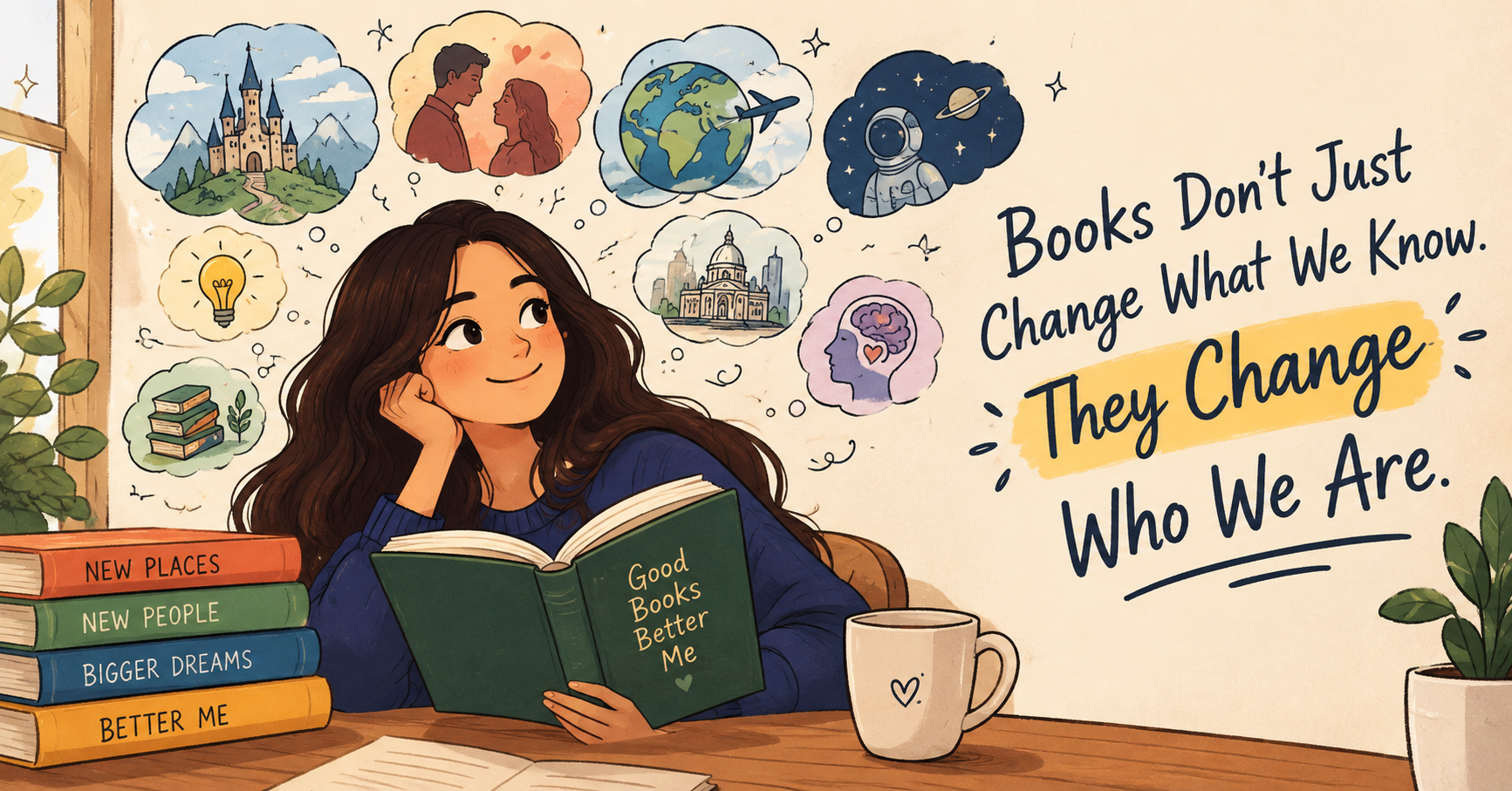

Think about the last book that really stayed with you.
Maybe it was a novel whose characters felt strangely real. Maybe it was a biography that made you rethink your own ambitions. Or perhaps it was a simple story you read years ago but still remember for one particular line.
That is the strange thing about books.
You finish reading them, close the cover, put them back on the shelf, and move on with your life. But sometimes, a small part of that book keeps moving with you.
You start looking at people differently. You question things you once accepted. You become curious about subjects you had never cared about before.
Books don't just give us something to read.
They quietly become part of who we are.
A Book Can Introduce You to a Person Who Never Existed
One of the most fascinating things about reading fiction is that you can become attached to someone who isn't even real.
You worry about a fictional character.
You get angry at them.
You celebrate when they succeed.
Sometimes, you even miss them after finishing the book.
And somewhere along the way, you begin to understand why they made certain choices.
That experience can teach us something about real people too.
Everyone has a story that we don't know.
The quiet person in the room may be dealing with something completely different from what we imagine. Someone who appears confident might be struggling with self-doubt. Someone who makes a terrible decision may have a history we know nothing about.
Books remind us that people are usually more complicated than the first impression we get from them.
The World Looks Bigger After You Read More
Imagine growing up in one city, surrounded by the same people, the same routines, and the same familiar ideas.
Then you start reading.
Suddenly, you're in Victorian England.
Then you're following a detective through a mysterious crime.
Then you're reading about someone's childhood in another country.
Then you're learning how an ancient civilization lived.
Then you're inside the mind of a scientist trying to solve a problem nobody else understands.
You haven't physically gone anywhere.
Yet your world has become much bigger.
That's one of the most beautiful things about books. They allow us to travel without packing a suitcase.
And sometimes, they introduce us to places we never knew we wanted to visit.
Books Can Mess With Your Opinions
And honestly, that's a good thing.
We all have opinions.
Some come from our families. Some come from school. Some come from friends, social media, television, or simply the environment in which we grew up.
But what happens when you read something that challenges one of those opinions?
You might disagree with the author.
You might get annoyed.
You might even close the book thinking, There is no way this person is right.
But then you keep thinking about it.
And that is where reading becomes interesting.
A good book doesn't always give you answers. Sometimes it gives you better questions.
It makes you stop and think, Why do I believe this?
That is how independent thinking develops.
Sometimes a Book Understands You Better Than People Do
There are moments when you read something and suddenly stop.
You read a paragraph describing a feeling you've had for years but never knew how to explain.
And you think:
"Wait. Someone else feels this too?"
That can be surprisingly powerful.
Books can put words to loneliness, ambition, heartbreak, insecurity, excitement, fear, or even those strange feelings that don't have an obvious name.
This is why people often return to certain books during difficult periods of their lives.
The story hasn't changed.
We have.
And suddenly, the same pages mean something completely different.
Reading Makes Your Imagination Do the Work
There's also something special about reading that movies and videos can't completely replace.
When you watch a movie, someone has already decided what the castle looks like, what the character looks like, how the street should appear, and what the sunset should feel like.
With a book, your brain has to build the world.
A sentence describes a mysterious old house.
Your imagination creates it.
A character walks into a crowded city.
Your mind fills the streets.
Someone falls in love.
You decide what that moment looks like.
In a strange way, reading is a collaboration between the writer and the reader.
The author provides the words.
You provide the world.
Books Also Show Us What Failure Looks Like
We often hear stories about successful people and their achievements.
But books can take us through the messy part too.
The failed experiment.
The terrible decision.
The rejected idea.
The relationship that fell apart.
The character who loses everything and has to start again.
These stories can be strangely comforting.
They remind us that failure isn't some unusual event reserved for unlucky people.
It is part of being human.
Sometimes, seeing someone struggle on a page makes our own struggles feel a little less frightening.
And Then There Are Books That Simply Make You Happy
Not every book needs to teach you something profound.
Sometimes you just want an exciting mystery.
Or a ridiculous comedy.
Or a fantasy world where dragons exist and ordinary rules don't matter.
Or a romance that makes you smile like an idiot.
And that's perfectly fine.
Entertainment is valuable too.
After a long day, getting lost in a story can be its own kind of escape. For a few hours, your phone stops mattering. Your notifications can wait. The world becomes whatever is happening on the page.
Sometimes, you don't need a lesson. You just need a good story.
The Books We Read Leave Little Traces Behind
Think about it.
You are not exactly the same person you were five years ago.
Part of that change came from your experiences. Part came from the people you met. Some came from mistakes.
And some of it may have come from books.
Maybe a character taught you something about courage.
Maybe a biography made you take your ambitions more seriously.
Maybe a novel made you more understanding of someone else's struggles.
Maybe a book introduced you to an entirely new subject.
We rarely notice these changes happening.
There is no dramatic moment where you finish a chapter and suddenly become a different person.
It happens quietly.
One idea at a time. One story at a time. One page at a time.
So, Why Do Books Matter?
Perhaps the real value of books isn't that they make us smarter.
It's that they make our inner world bigger.
They give us more experiences to think about, more people to understand, more questions to ask, and more ways to look at the same world.
A person who reads about many lives doesn't necessarily become wiser overnight.
But they have more perspectives to draw from.
And maybe that is the real magic of books.
You can finish a book in a week, but sometimes the book keeps changing you for years.
The cover closes.
The story ends.
But somewhere inside your mind, a little piece of it stays open.