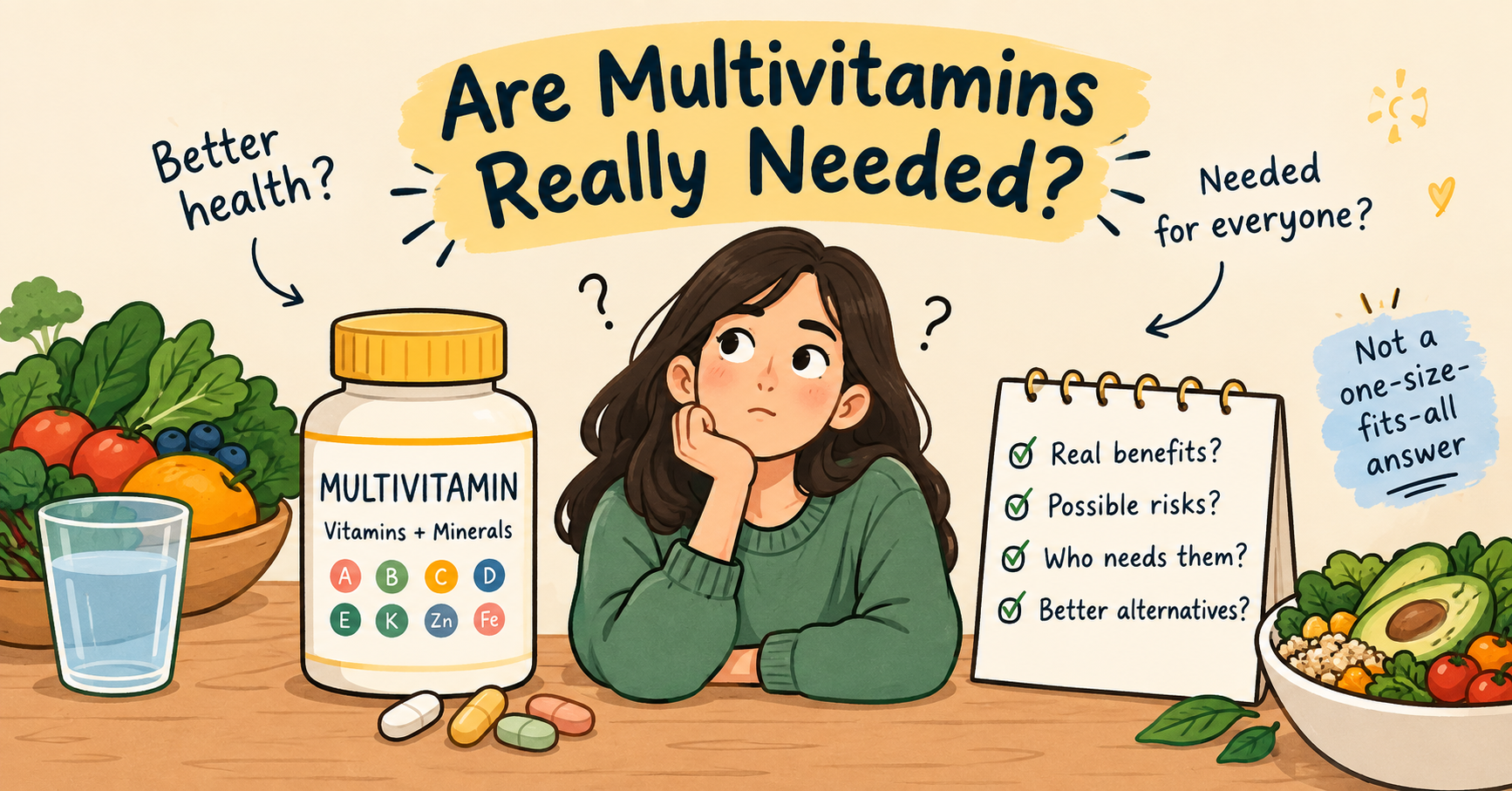

Walk into almost any pharmacy or health store and you will see shelves filled with multivitamins.
One bottle promises better immunity. Another focuses on energy. Some are marketed for hair, skin, bones, stress, fitness, or simply "overall health."
It can make you wonder: If vitamins are so important, shouldn't everyone be taking a multivitamin every day?
Not necessarily.
Vitamins and minerals are essential for the body, but that does not automatically mean everyone needs a multivitamin supplement. For many people, a varied and nutritious diet can provide most of the nutrients they need.
Supplements become more useful when diet, lifestyle, age, health conditions, or certain life stages make it difficult to meet nutritional needs through food alone.
So, before adding another bottle of pills to your morning routine, let's look at what multivitamins can actually do.
What Exactly Is a Multivitamin?
A multivitamin is a supplement containing a combination of vitamins and minerals. The exact ingredients and amounts can vary considerably from one product to another because there is no single standard formula for what a multivitamin must contain.
Depending on the product, it may contain nutrients such as:
- Vitamin A
- B vitamins
- Vitamin C
- Vitamin D
- Vitamin E
- Vitamin K
- Iron
- Zinc
- Iodine
- Selenium
- Calcium
- Magnesium
The idea is simple: if your diet falls short somewhere, a multivitamin can help fill some of those nutritional gaps.
But there is an important distinction here.
Filling a nutritional gap is not the same thing as making an already adequate diet healthier.
If I Eat Well, Do I Still Need One?
For many healthy adults, probably not as a routine requirement.
A diet containing a good variety of vegetables, fruits, whole grains, pulses, nuts, seeds, dairy or suitable alternatives, and protein sources can provide a wide range of essential nutrients. The World Health Organization emphasizes dietary diversity, adequacy and balance as the foundation of healthy eating.
Think of food as a complete package.
An orange does not just provide vitamin C. Foods also contain fiber and many other naturally occurring compounds that a multivitamin tablet cannot reproduce. The NIH similarly notes that multivitamins cannot replace the variety of foods in a healthy diet.
So taking a multivitamin does not turn an unhealthy diet into a healthy one.
You cannot really "supplement your way out" of a diet dominated by highly processed foods.
But What If My Diet Isn't Perfect?
This is where the answer becomes more interesting.
Real life isn't a nutrition textbook.
You might skip breakfast, eat whatever is available during a busy workday, dislike certain food groups, follow a restrictive diet, or simply struggle to eat a wide variety of foods.
In these situations, a multivitamin may provide some nutritional insurance.
The NIH notes that people with poor nutrient intake, low-calorie diets, or diets that exclude certain foods may benefit from a multivitamin. Healthcare professionals may also recommend supplements when medical conditions interfere with digestion or nutrient absorption.
The important word is may.
It doesn't mean everyone with a busy lifestyle automatically needs one.
Who Might Actually Need Extra Nutrients?
Certain people are more likely to require specific supplements than the average healthy adult.
1. People With Confirmed Nutrient Deficiencies
If testing shows that you are deficient in a particular nutrient, your doctor may recommend supplementation.
In this situation, taking a targeted supplement can make much more sense than randomly choosing a high-dose multivitamin.
2. Pregnant People or Those Planning Pregnancy
Pregnancy changes nutritional requirements considerably.
For people who are planning pregnancy or capable of becoming pregnant, the USPSTF recommends daily folic acid supplementation to reduce the risk of neural tube defects.
Pregnancy supplements should therefore be treated as a specific nutritional need rather than simply another general wellness product.
3. People Following Restrictive Diets
Some diets eliminate entire food groups.
For example, people following strict vegetarian or vegan diets may need particular nutrients to be monitored, depending on their food choices and overall diet. The NIH specifically identifies strict vegetarians and vegans among groups who may benefit from an MVM in some circumstances.
That does not mean every vegetarian needs a multivitamin. It means their nutritional intake deserves more attention.
4. Older Adults
Nutritional needs can change with age.
Some older adults may have difficulty consuming enough food, absorbing certain nutrients, or obtaining adequate amounts from their diet. Certain multivitamin formulations for older adults therefore contain different amounts of nutrients than products designed for younger adults.
Again, individual needs matter more than the label on the bottle.
Can Multivitamins Prevent Disease?
This is where marketing can get ahead of science.
You may see supplements promoted as a way to protect your heart, boost longevity, prevent cancer or keep serious diseases away.
The evidence is much less dramatic.
The U.S. Preventive Services Task Force found insufficient evidence to determine whether multivitamins provide more benefits than harms for preventing cardiovascular disease or cancer in healthy, nonpregnant adults.
A large evidence review involving hundreds of thousands of participants found little or no overall benefit from vitamin and mineral supplementation for preventing cancer, cardiovascular disease and death, although it identified a small possible benefit for cancer incidence with multivitamin use and noted important limitations in the evidence.
So taking a multivitamin should not be viewed as a replacement for the things with much stronger evidence behind them, such as eating a nutritious diet, staying physically active, sleeping adequately and avoiding tobacco.
More Vitamins Doesn't Mean More Health
This is one of the easiest mistakes to make.
If a little vitamin is good for you, it may seem logical that more must be even better.
Your body doesn't work that way.
Some vitamins and minerals can cause problems when consumed in excessive amounts. The risks depend on the nutrient, dose, duration and the person's circumstances.
For example, the USPSTF specifically recommends against using beta-carotene or vitamin E supplements for the prevention of cardiovascular disease or cancer in healthy, nonpregnant adults.
Certain supplements can also interact with medications. The NIH, for example, notes that vitamin K can interfere with the effectiveness of the blood thinner warfarin.
That's why "it's only a vitamin" isn't always a good reason to take something casually.
So, Should You Take a Multivitamin?
Instead of asking:
"Should everyone take a multivitamin?"
A better question is:
"Do I have a reason to take one?"
That reason could be a confirmed deficiency, a restrictive diet, pregnancy, a medical condition affecting nutrient absorption, inadequate dietary intake, or another situation where a healthcare professional has identified a nutritional need.
If none of these apply and your diet is varied and balanced, you may not need a multivitamin simply because everyone online seems to be taking one.
A Better Way to Think About Supplements
Think of a multivitamin as a backup plan, not the foundation of your diet.
Your foundation should still be real food.
Vegetables. Fruits. Whole grains. Pulses. Nuts and seeds. Protein-rich foods. Healthy fats. Fortified foods when appropriate.
Supplements can have their place, but they should complement a good diet rather than become an excuse to ignore one.
And if you suspect that you're tired because of a vitamin deficiency, have unexplained symptoms, follow a highly restrictive diet, or take medications that could interact with supplements, it's worth discussing your situation with a doctor or registered dietitian rather than guessing from a supplement label.
The Bottom Line
So, are multivitamins really needed?
For some people, yes.
For everyone, no.
Multivitamins can be useful when they address a genuine nutritional gap. But they aren't magic pills, and taking one does not automatically make a person healthier.
The healthiest approach is surprisingly simple: build your diet around a variety of nutritious foods, identify actual nutritional gaps, and use supplements when there is a good reason for them.
Your daily health probably depends much more on what you consistently put on your plate than on how many pills are sitting beside it.