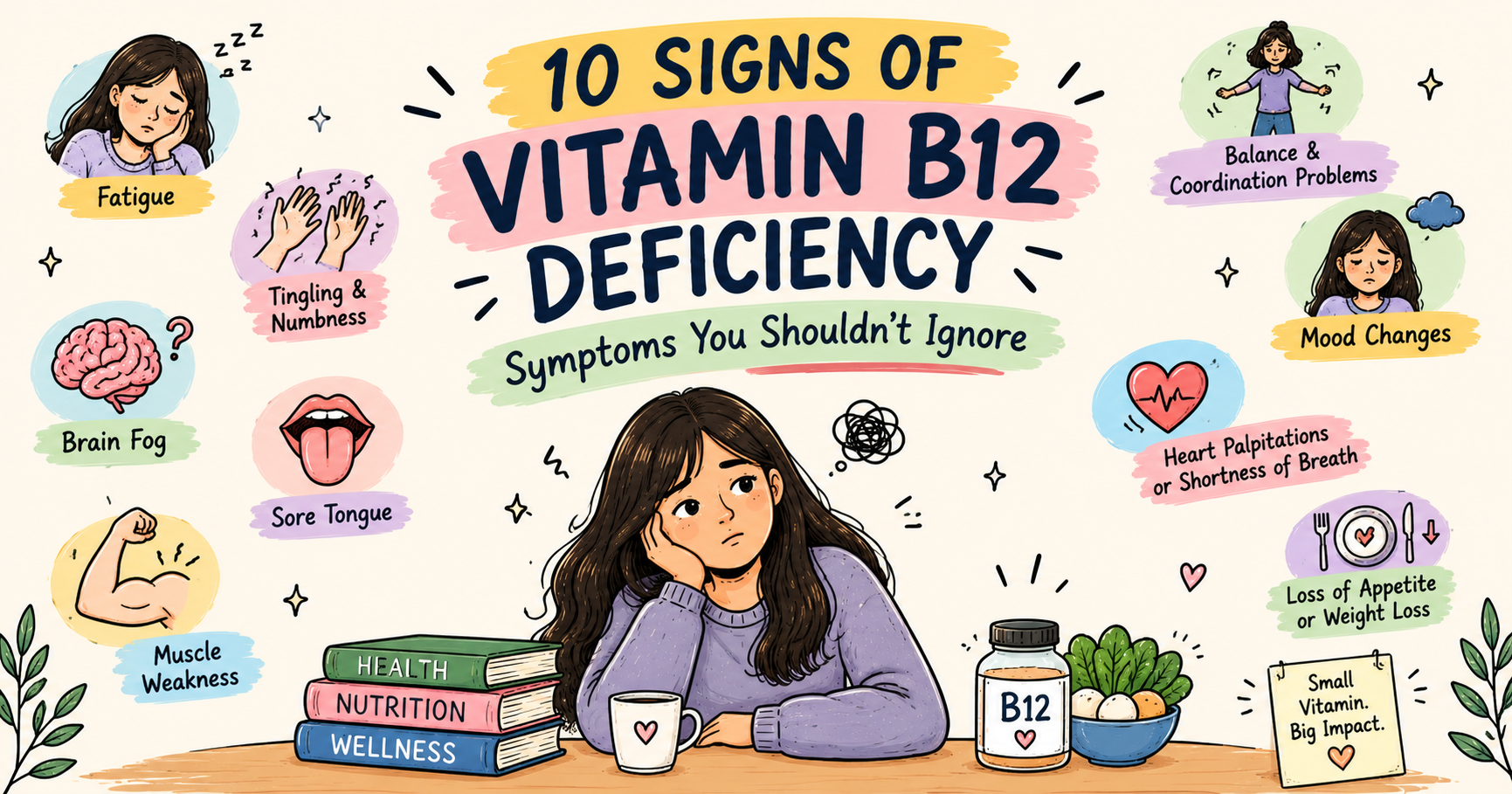

Feeling tired all the time? Getting frequent tingling in your hands or feet? Finding it harder to concentrate than usual?
These symptoms are easy to blame on stress, poor sleep, a busy schedule, or simply having a bad week.
But sometimes, they can be signs of something else.
Vitamin B12 deficiency can affect the blood, nervous system, and overall energy levels. What makes it particularly tricky is that symptoms can develop gradually, and some people may experience neurological symptoms even without the classic anemia associated with B12 deficiency.
The good news is that vitamin B12 deficiency can usually be identified through appropriate testing and treated.
So, what are the warning signs?
Let's break them down.
What Is Vitamin B12 and Why Does Your Body Need It?
Vitamin B12, also called cobalamin, is a water-soluble vitamin that plays an important role in:
- Red blood cell production
- DNA synthesis
- Normal nervous-system function
- Neurological health
Your body stores a significant amount of vitamin B12, which means deficiency can take years to develop in some people.
Vitamin B12 is naturally found primarily in animal-derived foods such as meat, fish, eggs, and dairy. Some plant-based foods, including certain breakfast cereals and nutritional products, are fortified with B12.
This is one reason people following vegan diets need to pay particular attention to reliable sources of vitamin B12.
10 Signs of Vitamin B12 Deficiency
Vitamin B12 deficiency doesn't look exactly the same in everyone.
Some people notice physical symptoms first, while others experience neurological or cognitive changes.
Here are some signs worth knowing.
1. Constant Fatigue and Low Energy
One of the most common symptoms associated with vitamin B12 deficiency is unusual tiredness or weakness.
You may feel exhausted even after what seems like a normal night's sleep.
Why?
B12 is involved in red blood cell production. A deficiency can contribute to megaloblastic anemia, which reduces the body's ability to transport oxygen efficiently.
You might notice:
- Feeling unusually tired
- Low energy
- Weakness
- Reduced ability to exercise
- Getting tired more easily than usual
However, fatigue has many possible causes, including iron deficiency, thyroid problems, sleep disorders, stress, infections, and other medical conditions.
So fatigue alone doesn't mean you have a B12 deficiency.
2. Tingling or Numbness in Your Hands and Feet
This is one of the symptoms you shouldn't casually ignore.
Vitamin B12 deficiency can affect the nervous system and may cause:
- Pins and needles
- Tingling
- Numbness
- Burning sensations
- Reduced sensation in the hands or feet
These symptoms can develop gradually and may initially seem minor.
But prolonged B12 deficiency can cause neurological damage, and some neurological problems may become permanent if treatment is delayed.
If you develop unexplained or persistent numbness or tingling, speak with a healthcare professional rather than assuming it's simply poor circulation.
3. Brain Fog and Difficulty Concentrating
Have you noticed that you're having trouble focusing on things that normally feel easy?
Some people with B12 deficiency experience:
- Difficulty concentrating
- Memory problems
- Confusion
- Cognitive changes
- Difficulty thinking clearly
These symptoms are sometimes casually called “brain fog.”
But brain fog isn't specific to B12 deficiency.
Poor sleep, stress, anxiety, depression, medication, hormonal changes, and several medical conditions can also affect concentration.
If cognitive changes persist or are getting worse, it's worth discussing them with a healthcare professional.
4. A Pale Appearance or Changes in Skin Color
B12 deficiency can cause anemia, which may make the skin appear unusually pale.
Some people may also develop changes such as yellowish skin because of changes associated with abnormal red blood cell breakdown.
However, changes in skin color have many possible causes.
Don't use skin appearance alone to diagnose a vitamin deficiency.
5. A Sore or Red Tongue
Here's a symptom many people don't associate with vitamin deficiency.
Vitamin B12 deficiency can cause glossitis, an inflammation of the tongue.
Your tongue may feel:
- Sore
- Smooth
- Swollen
- Red
- Burning or uncomfortable
Mouth ulcers can also occur.
If mouth or tongue changes persist, it's worth getting them evaluated rather than simply treating them with home remedies.
6. Muscle Weakness
B12 deficiency can affect the nervous system, which may contribute to muscle weakness.
You might notice that everyday activities feel harder than usual or that your physical coordination isn't what it normally is.
Muscle weakness can have many causes, so it shouldn't automatically be attributed to B12.
But when it appears alongside symptoms such as numbness, tingling, balance problems, or fatigue, it deserves medical attention.
7. Balance and Coordination Problems
More significant neurological B12 deficiency can affect coordination and balance.
You may notice:
- Feeling unsteady while walking
- Difficulty maintaining balance
- Clumsiness
- Changes in coordination
These symptoms are particularly important because neurological complications can become serious if deficiency remains untreated.
If you suddenly develop significant balance or coordination problems, don't assume it's a vitamin issue. Seek prompt medical evaluation.
8. Mood Changes
Vitamin B12 deficiency has been associated with neuropsychiatric symptoms, including:
- Irritability
- Depression
- Anxiety
- Confusion
- Cognitive changes
However, this doesn't mean that depression or anxiety is caused by B12 deficiency.
Mental health is influenced by many biological, psychological, and social factors.
If you're experiencing persistent changes in mood, professional support is important regardless of whether a vitamin deficiency is involved.
9. Heart Palpitations or Shortness of Breath
When B12 deficiency causes anemia, the heart may need to work harder to deliver enough oxygen to the body.
This can contribute to symptoms such as:
- Heart palpitations
- Shortness of breath
- Rapid heartbeat
- Headaches
- Weakness
- Fatigue
These symptoms aren't unique to B12 deficiency.
Palpitations or unexplained shortness of breath should be medically evaluated, particularly if they're severe, persistent, or accompanied by chest pain, fainting, or significant difficulty breathing.
10. Loss of Appetite or Unexplained Weight Loss
Vitamin B12 deficiency can sometimes be associated with:
- Reduced appetite
- Weight loss
- Digestive symptoms
The NIH notes loss of appetite and weight loss among possible symptoms of B12 deficiency.
But unexplained weight loss should never automatically be blamed on a vitamin deficiency.
If you're losing weight without intentionally changing your diet or activity, speak with a healthcare professional.
Vitamin B12 Deficiency Symptoms at a Glance
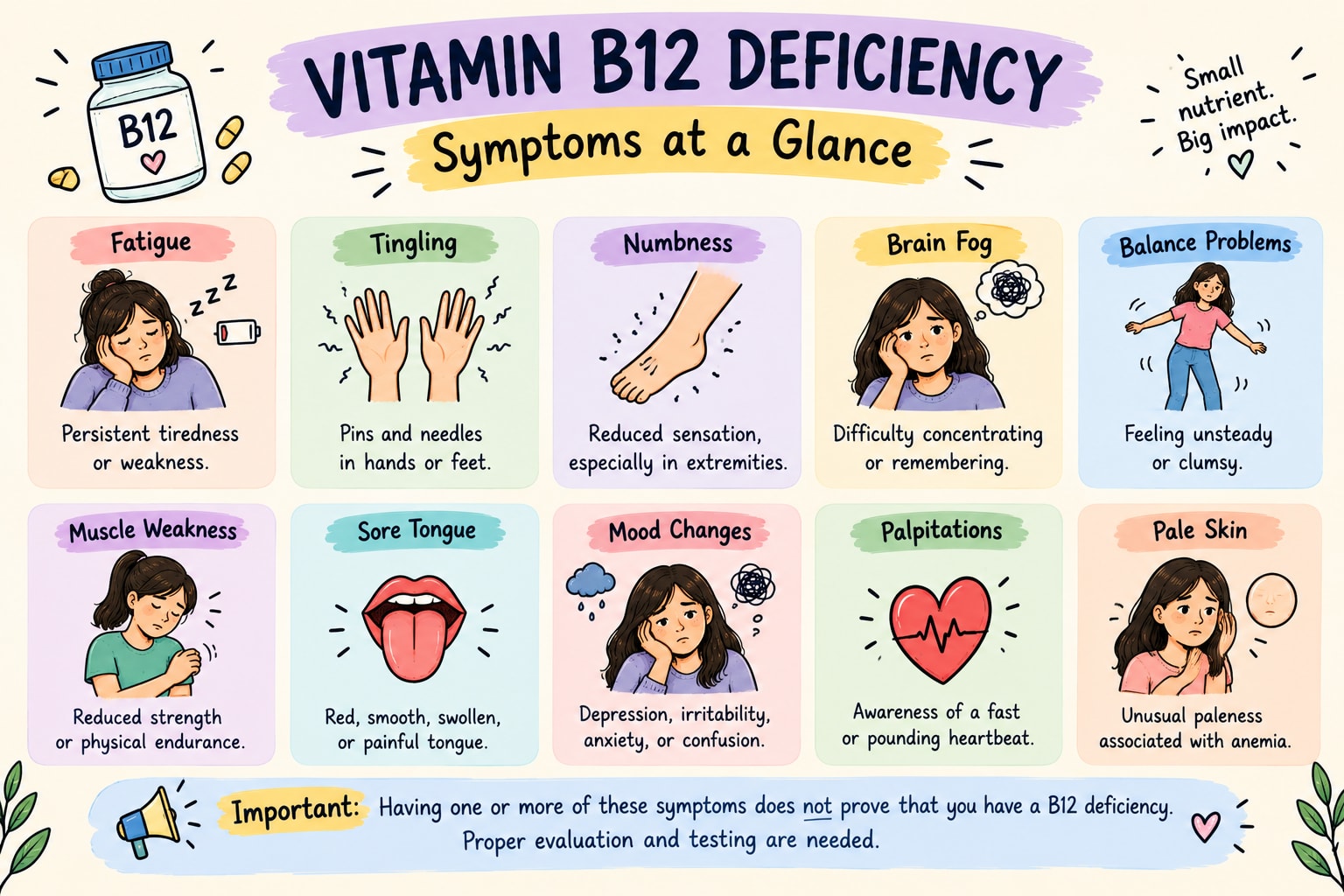
Important: Having one or more of these symptoms does not prove that you have a B12 deficiency. Proper evaluation and testing are needed.
Who Is More Likely to Develop Vitamin B12 Deficiency?
B12 deficiency isn't only a concern for people who don't eat meat.
Several factors can increase risk.
1. People Following Vegan or Strict Vegetarian Diets
Natural B12 is found primarily in animal-derived foods, although fortified foods and supplements can provide B12.
People who avoid all animal products should make sure they have a reliable source of vitamin B12.
2. Older Adults
The ability to absorb vitamin B12 can decrease with age, and older adults may have conditions or medications that interfere with absorption.
3. People Taking Metformin
Long-term metformin use is associated with an increased risk of vitamin B12 deficiency.
People taking metformin may therefore need periodic B12 assessment depending on their individual circumstances.
4. People Taking Acid-Reducing Medications
Long-term use of certain acid-reducing medicines, including proton pump inhibitors, can interfere with B12 absorption from food.
Don't stop prescribed medication on your own.
If you're concerned about B12 levels, discuss it with your healthcare professional.
5. People With Digestive or Absorption Problems
Certain gastrointestinal conditions or surgeries can interfere with vitamin B12 absorption.
Examples include:
- Crohn's disease affecting the ileum
- Certain gastrointestinal surgeries
- Atrophic gastritis
- Pernicious anemia
B12 absorption is a complicated process involving intrinsic factor and the small intestine, so someone can consume enough B12 and still become deficient if absorption is impaired.
Can You Have B12 Deficiency Without Anemia?
Yes.
This is an important point.
Many people associate B12 deficiency exclusively with anemia, but neurological symptoms can occur even when someone does not have obvious anemia.
That's why symptoms such as persistent numbness, tingling, balance problems, or cognitive changes shouldn't automatically be dismissed because a person doesn't appear anemic.
How Is Vitamin B12 Deficiency Diagnosed?
You can't reliably diagnose B12 deficiency based on symptoms alone.
A healthcare professional may consider:
- Your symptoms
- Diet
- Medical history
- Medications
- A complete blood count
- Serum vitamin B12 testing
- Additional tests when necessary
If B12 levels are borderline, a doctor may use methylmalonic acid (MMA) testing to help clarify whether a deficiency is present. The NIH notes that MMA is one of the most sensitive markers of B12 status, although kidney function can affect its interpretation.
A 2025 review in American Family Physician similarly recommends considering MMA testing when B12 levels are borderline.
This is why buying a B12 supplement and assuming every symptom is caused by deficiency isn't the best approach.
Foods That Contain Vitamin B12
If you're trying to maintain adequate B12 intake, foods containing vitamin B12 include:
Animal sources
- Fish
- Meat
- Poultry
- Eggs
- Milk
- Yogurt
- Other dairy products
Fortified sources
Some:
- Breakfast cereals
- Plant-based milk
- Nutritional products
may contain added vitamin B12.
Always check the nutrition label because the amount varies between products.
For people following a vegan diet, fortified foods or a reliable B12 supplement are particularly important because unfortified plant foods generally don't provide dependable amounts of B12.
Can You Prevent Vitamin B12 Deficiency?
For many people, yes.
The key is ensuring that you consistently get enough B12 from your diet, fortified foods, or supplements when appropriate.
However, diet isn't always the whole story.
Someone can consume B12 regularly and still become deficient because of an absorption problem or certain medications.
That's why recurring symptoms or risk factors deserve proper evaluation rather than simply increasing dietary B12.
When Should You See a Doctor?
Don't wait for symptoms to become severe.
Consider speaking with a healthcare professional if you have:
- Persistent unexplained fatigue
- Recurrent numbness or tingling
- Balance or coordination problems
- Persistent cognitive changes
- Unexplained weakness
- A sore or unusually red tongue
- Unexplained weight loss
- Symptoms combined with a known B12 risk factor
B12 deficiency is generally treatable, but neurological complications can become harder to reverse when deficiency remains untreated for a long time.
The Bottom Line
Vitamin B12 deficiency can be surprisingly easy to overlook because its symptoms often resemble problems we encounter every day.
You're tired.
Maybe you need more sleep.
You're struggling to concentrate.
Maybe you're stressed.
Your hands are tingling.
Maybe you've been sitting awkwardly.
Sometimes those explanations are correct.
But persistent or unexplained symptoms, particularly when several appear together, deserve attention.
Vitamin B12 plays an essential role in red blood cell production and nervous-system function, and deficiency can cause both blood-related and neurological problems.
The most important takeaway isn't to panic over every symptom.
It's to recognize the signs, understand your risk factors, and get appropriate testing when necessary.
Your body doesn't always send a dramatic warning.
Sometimes, it starts with something as simple as feeling unusually tired.
Frequently Asked Questions
What is the first sign of vitamin B12 deficiency?
There isn't one universal first symptom. Fatigue and weakness are common, while numbness or tingling can also occur. Symptoms may develop gradually over time.
Can B12 deficiency cause hair loss?
Hair loss is frequently mentioned online as a B12 deficiency symptom, but it is not among the most characteristic manifestations. Hair loss has many possible causes, so it shouldn't be used by itself to diagnose B12 deficiency.
Can B12 deficiency cause anxiety or depression?
B12 deficiency can be associated with neuropsychiatric symptoms, including depression, anxiety, irritability, and cognitive changes. However, these symptoms have many possible causes and do not establish a B12 deficiency diagnosis.
Can you have B12 deficiency with a normal blood count?
Yes. Neurological manifestations can occur without the classic anemia associated with B12 deficiency.
How long does it take for B12 deficiency symptoms to appear?
Because the body stores substantial amounts of vitamin B12, symptoms can take years to develop after intake or absorption becomes inadequate.
Is vitamin B12 deficiency treatable?
Yes. Treatment depends on the cause and severity. Oral B12 supplementation is effective for many people, while injections may be considered in cases of severe deficiency or significant neurological symptoms.